kingpinless caster wheel banner

What Are Kingpinless Casters?

Kingpinless casters are heavy-duty industrial casters engineered to eliminate the single biggest point of failure found in traditional caster design — the kingpin. In a standard kingpin caster, a central bolt (the kingpin) holds the swivel raceways and ball bearings together. While this design works for lighter applications, it creates a critical weakness under heavy loads. Shock loads, overloading, and repetitive impacts can cause the kingpin to stretch, loosen, or break entirely — leading to caster failure, equipment downtime, and potential safety hazards on the plant floor.

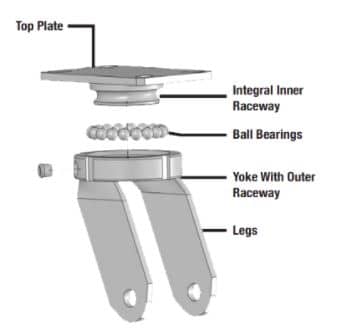
The kingpinless caster design solves this by removing the bolt altogether. Instead of relying on a single fastener, kingpinless casters use a hardened steel inner and outer raceway with the load distributed across a single row of precision hardened ball bearings. The result is a caster with no single point of failure — one that delivers greater impact resistance, higher load capacities, and proven durability in heavy-duty intralogistics environments where downtime is not an option.

At Barron Equipment, kingpinless casters are our most popular industrial caster category. We assemble our casters in house, and our team has the hands-on expertise to help you match the right caster design to your specific operation.

Kingpin vs. Kingpinless: How the Design Differs

Understanding the difference between these two caster designs is essential when specifying high-capacity casters for industrial use.

A kingpin caster uses three main components bolted together: a top plate with a raceway, a lower fork with a matching raceway, and a vertical kingpin bolt that holds the assembly together. The ball bearings in the raceway carry the rotational load, but the kingpin itself bears all of the axial stress. Over time — especially under shock loads from dock plate crossings, forklift impacts, or heavy towing — that bolt fatigues. The swivel begins to wobble, the raceway wears unevenly, and eventually the caster fails.

A kingpinless caster eliminates this vulnerability. The raceway is machined directly into the forged swivel section, creating one continuous assembly. Side loads, vertical loads, and shock loads are all absorbed by the full forged section rather than concentrated at a single bolt. There is no kingpin to loosen, no preload to verify, and no bolt to replace.
Kingpin Style
Kingpin Style
Kingpinless Style
Kingpinless Style

Benefits of Kingpinless Casters

The engineering benefits of the kingpinless caster design translate directly into operational benefits for your facility.

Greater Impact Resistance
— Without a central bolt to shear under stress, kingpinless casters absorb shock loads from uneven floors, expansion joints, dock plates, and debris without the risk of catastrophic caster failure.

Higher Load Capacities
— Kingpinless casters at Barron Equipment support load capacities ranging from 650 lbs per caster in our standard series up to 8,000 lbs per caster in our super heavy-duty series. For high heat applications, forged steel wheel configurations push the capacity range even higher.

Longer Service Life
— By eliminating the kingpin — the component most prone to fatigue — these heavy-duty casters last significantly longer in demanding environments. This means fewer replacements, less downtime, and lower total cost of ownership.

Improved Ergonomics
— The precision raceway design of kingpinless casters reduces the push/pull force required to swivel the caster under load. This makes them a strong choice for applications where employee safety and ergonomics are a priority.

Floor Protection
— When paired with polyurethane or nylon caster wheels, kingpinless casters provide excellent floor protection while maintaining high load capacities — an important consideration for facilities with finished concrete or coated floors.


Applications
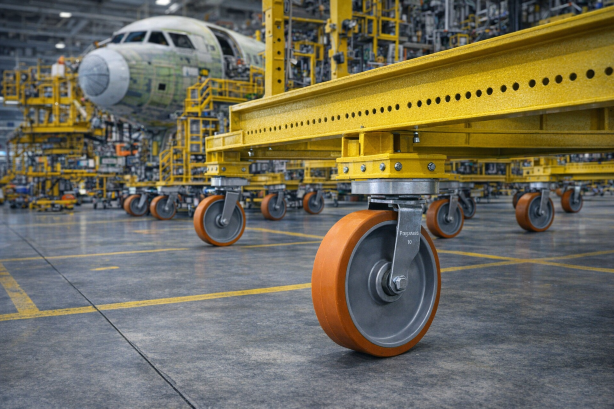
Kingpinless casters are the standard specification for heavy-duty intralogistics — the internal movement of materials, parts, and products within manufacturing and warehouse environments where ergonomics, repetitive use, and heavy loads are part of daily operations. Common applications include:
 
Aerospace — Multi-ton assembly jigs and moveable tooling where precision and zero-failure tolerance are essential.
 
Automotive — Body-in-white carts, transfer carts, and tow-line systems in assembly plants where consistent swivel performance prevents product damage.
 
Bakeries & Food Processing — Rack ovens, proofing carts, and transport carts that require high temperature casters capable of handling heat applications alongside heavy loads.
 
Medical & Pharmaceutical — Heavy equipment carts and supply systems requiring smooth, reliable mobility with ergonomic benefits.
 
Tire Manufacturers — Transfer carts and material handling equipment subject to repetitive high-load cycles.
 
Towing & Tow Lines — Tow-line cart systems where shock loads from sudden starts and stops would destroy traditional kingpin casters.
kingpinless caster in aerospace industry

Kingpinless Caster Series at Barron Equipment

Barron Equipment offers three tiers of kingpinless casters, each with swivel and rigid configurations:
 
Kingpinless Casters — 60 Series (Swivel) & 61 Series (Rigid). Our standard kingpinless industrial casters with load capacities ranging from 650 to 1,500 lbs per caster. An ideal step up from the 40 series for applications that need better ergonomics and a longer service life.
 
Heavy Duty Kingpinless Casters — 70 Series (Swivel) & 71 Series (Rigid). Engineered for higher load capacities and more demanding industrial environments. These heavy load casters bridge the gap between standard and super heavy-duty applications.
 
Super Heavy Duty Kingpinless Casters — 80 Series (Swivel) & 81 Series (Rigid). The heaviest duty option at Barron Equipment, with a maximum load capacity of 8,000 lbs per caster. Designed for steel mill carts, foundry equipment, defense logistics, and other extreme-duty applications.
 
Series ending in “0” are swivel casters. Series ending in “1” are rigid casters. If your application uses both types on the same cart, your rigid caster sizes will need to match your swivel caster sizes.

Wheel Material & Brake Options

All kingpinless series are available with a variety of caster wheel materials, including polyurethane, phenolic, cast iron, forged steel, and nylon. For high heat applications — such as ovens, autoclaves, and powder coating lines — forged steel wheels and steel casters are the recommended configuration.
 
Brake options are also available across these series. To learn about the different brake types Barron offers, check out our guide — Braking Ground: A Comprehensive Guide to Diverse Industrial Caster Brake Types.
 
Custom applications are available. For more information, email us at casters@barroneq.com.

FAQs

What is a kingpinless caster?

A kingpinless caster is an industrial caster that eliminates the traditional kingpin bolt found in standard swivel casters. Instead of using a central bolt to hold the swivel assembly together, kingpinless casters feature a hardened steel inner and outer raceway with the load distributed across precision ball bearings. This design removes the most common failure point in heavy-duty caster applications and delivers greater impact resistance, higher load capacities, and a longer service life.
 

What is the difference between kingpin and kingpinless casters?

A kingpin caster relies on a single vertical bolt to hold the swivel raceways together. Under shock loads or heavy use, that bolt can stretch, loosen, or break — causing swivel wobble and eventual failure. A kingpinless caster machines the raceway directly into the forged swivel section, so there is no bolt to fail. Side loads and shock loads are absorbed by the entire forged assembly rather than concentrated at one fastener.
 

When should I upgrade from kingpin to kingpinless casters?

Consider upgrading to kingpinless casters if your application involves loads above 650 lbs per caster, regular shock loads from dock plate crossings or tow-line operations, repetitive heavy use in manufacturing, or if you’re experiencing frequent caster failures with kingpin designs. The cost premium typically pays for itself through reduced replacements and downtime.
 

What load capacity range do kingpinless casters support?

At Barron Equipment, kingpinless casters range from 650 lbs per caster in the standard 60/61 series up to 8,000 lbs per caster in the super heavy-duty 80/81 series. The right capacity depends on your total cart weight, shock load conditions, and the number of casters per cart. Our caster specialists can help you calculate the correct specification.
 

Can kingpinless casters be used in high-temperature environments?

Yes. When paired with forged steel wheels or cast iron wheels, kingpinless casters can handle high heat applications such as ovens, autoclaves, smokehouses, and powder coating lines. The steel raceway and hardened ball bearings in the kingpinless design are well suited for sustained high-temperature exposure.
 

What wheel materials are available for kingpinless casters?

Barron Equipment offers kingpinless casters with polyurethane, phenolic, cast iron, forged steel, and nylon wheels. Polyurethane provides the best floor protection and noise reduction. Forged steel handles the highest loads and temperatures. Phenolic is an economical choice for medium-duty applications. Your caster specialist can recommend the best wheel material for your specific environment.


Selection Assistance

Not sure which kingpinless caster is right for your application? At Barron Equipment, we have a team of caster specialists who assist with everything from standard configurations to fully custom solutions. With the wide range of load capacities, top plate sizes, caster wheel materials, and brake options available, our experts can direct you to the right caster for your operation. Fill out the form below and a caster specialist will be in touch soon!
 
Contact Us

Summary

Captcha


Upload PO

Save 10% on Crane + Rigging Cabinet Bundles