
FIND US
Davenport, IA
4710 N Brady St
Davenport, IA 52806
Des Moines, IA
2276 NE 46th Ave
Des Moines, IA 50317
Vertical Reciprocating Conveyors
-

4XLift™ Heavy Duty Material Lift
Read more -
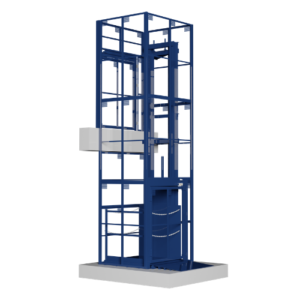
Autoquip FreightLite Hydraulic Freight Lift – Light Duty VRC for Mezzanine Transfer
Read more -
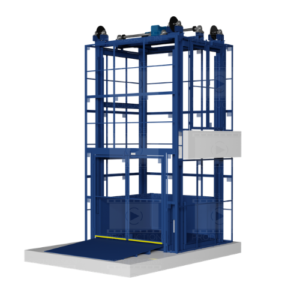
Autoquip Mechanical 4 Post VRC – High Capacity Freight Lift for Multi-Level Transfer
Read more -

Custom Hydraulic Lifts
Read more -

Delta™ VRC Material Lift
Read more -
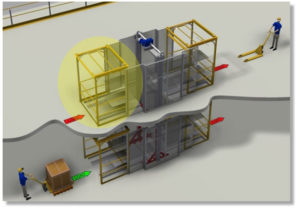
FlexLoader™ Material Conveyor System
Read more -

Hydraulic Cantilever VRC
Read more -

Hydraulic Straddle VRC
Read more -

Hydraulic Vertical Lifts – 21 Series
Read more -

Hydraulic Vertical Lifts – D Series
Read more -

Mechanical Cantilever VRC
Read more -

Mechanical Cantilever VRCs
Read more
What Is a Vertical Reciprocating Conveyor?
A VRC uses a guided carriage and either hydraulic or mechanical actuation to transport pallets, carts, boxes, inventory, and equipment between fixed elevations. These systems help facilities move materials vertically without relying on forklifts, ramps, or freight elevators.
Common applications include:
- Mezzanine storage access
- Warehouse inventory movement
- Multi-level manufacturing operations
- Conveyor integration
- Pallet and cart transfer
- Distribution-center material handling
VRCs are classified as conveyors under ASME B20.1 – Safety Requirements for Conveyors and Related Equipment and are designed for material handling only. They are not approved for passenger transport.
Types of Vertical Reciprocating Conveyors
Hydraulic VRCs
Hydraulic VRCs use direct-acting hydraulic cylinders to move the carriage. These systems are commonly selected for:
- Two-level lifting
- Mezzanine access
- Moderate cycle rates
- General warehouse applications
Products in this category include:
- Hydraulic Cantilever VRC
- Hydraulic Straddle VRC
- Hydraulic Vertical Lifts – 21 Series
- Hydraulic Vertical Lifts – D Series
- FreightLite Hydraulic Freight Lift
Mechanical VRCs
Mechanical VRCs use electric motors, chains, and drive systems to move materials between levels.
These systems are typically used for:
- Multi-level facilities
- Higher-cycle applications
- Conveyor integration
- Automated material handling
- Higher-throughput operations
Products in this category include:
- 4XLift™ Heavy Duty Material Lift
- Mechanical 4 Post VRC
- Mechanical Cantilever VRC
- Delta™ VRC Material Lift
- FlexLoader™ Material Conveyor System
Hydraulic vs. Mechanical VRC Comparison
| Attribute | Hydraulic VRC | Mechanical VRC |
|---|---|---|
| Actuation Method | Hydraulic cylinders | Chain-driven electric motor |
| Typical Application | Mezzanines and two-level transfer | Multi-level and automated transfer |
| Level Capability | Typically two levels | Two or more levels |
| Cycle Requirements | Moderate-cycle operation | Higher-cycle and continuous operation |
| Automation Integration | Limited by application | Excellent for conveyor integration |
| Representative Products | 21 Series, D Series, FreightLite | 4XLift™, Delta™, Mechanical 4 Post |
Cantilever vs. Straddle vs. 4-Post Designs
Cantilever VRCs
Cantilever systems support the carriage from one side, providing more open access to the lift platform.
Straddle VRCs
Straddle designs use support structures on both sides of the carriage to provide stability for material movement.
4-Post VRCs
Four-post configurations create a rigid lifting structure for demanding applications, larger platforms, and heavier-duty operation.
Configuration selection depends on the available footprint, loading direction, platform requirements, and facility layout.
VRC vs. Freight Elevator
A common misconception is that a VRC and a freight elevator are the same thing.
Vertical Reciprocating Conveyor
- Material transport only
- Governed by ASME B20.1
- Used in warehouses, factories, and distribution facilities
- Designed around material handling
Freight Elevator
- Associated with elevator-code requirements
- Governed under a different code framework
- Evaluated differently during facility planning
The appropriate solution depends on the project requirements, intended usage, and applicable regulations.
VRC vs. Forklift
Many facilities install VRCs to reduce repeated forklift trips between floor levels.
Instead of moving pallets up ramps or through other vertical pathways, a VRC provides a dedicated lifting system designed specifically for material movement.
Common reasons facilities evaluate VRCs instead of repeated forklift movement include:
- Multi-level inventory transfer
- Mezzanine access
- Production support
- Conveyor-line integration
- Repetitive material movement
The report also identifies VRCs as utilizing safety devices such as landing gates, interlocks, overload detection systems, and braking systems depending on the manufacturer and configuration.
Manufacturers We Carry
Wildeck
Wildeck offers modular, mechanical, hydraulic, and automated VRC systems including:
- 4XLift™
- Delta™ VRC
- FlexLoader™
Autoquip
Autoquip manufactures hydraulic and mechanical freight lifts and VRC systems commonly used for mezzanine access and multi-level transfer.
PFlow Industries
PFlow Industries specializes in hydraulic VRC systems including:
- Hydraulic Vertical Lifts – 21 Series
- Hydraulic Vertical Lifts – D Series
What Information Is Needed for a Quote?
Before requesting a quote, gather:
- Maximum load weight
- Platform dimensions
- Floor-to-floor rise
- Number of levels
- Estimated cycles per hour
- Indoor or outdoor installation requirements
- Loading and unloading direction
- Available floor space
Providing these details helps determine the most appropriate VRC configuration.
ASME B20.1 Compliance
The VRC products represented on this page are associated with ASME B20.1 – Safety Requirements for Conveyors and Related Equipment. This standard addresses conveyor design, guarding, safety gates, operating controls, and other material-handling requirements. Proper installation, inspection, maintenance, and operation remain important parts of a safe material-handling program.
Industries Served
Vertical reciprocating conveyors are commonly used in:
- Warehouses
- Manufacturing facilities
- Distribution centers
- Retail back-room storage
- Food-processing operations
- Automotive facilities
- Mezzanine systems
- Industrial material-handling environments
Frequently Asked Questions
What is a vertical reciprocating conveyor?
A VRC is a material-only lifting system used to move loads between floor levels. It is also commonly called a material lift, freight lift, or pallet lift.
What is the difference between a hydraulic and mechanical VRC?
Hydraulic systems use cylinders and are often selected for two-level applications. Mechanical systems use motors and chains and are commonly selected for higher-cycle and multi-level applications.
Can people ride a VRC?
No. VRCs are designed exclusively for material transport and are not approved for passenger use.
What safety standard applies to VRCs?
The analysis identifies ASME B20.1 as the governing standard associated with the VRC products represented on this page.
How do I get a quote?
Provide your load weight, platform dimensions, vertical rise, number of levels, cycle requirements, and installation conditions. Barron Equipment can recommend the appropriate VRC configuration based on your application.
Vertical Reciprocating Conveyor Selection
Barron Equipment helps warehouses, manufacturers, distribution centers, and industrial facilities evaluate hydraulic and mechanical VRC systems based on load requirements, rise height, levels served, automation goals, and facility layout.
Request a quote online to discuss the best vertical material-handling solution for your application.