Durable Doors for Commercial and Industrial Openings
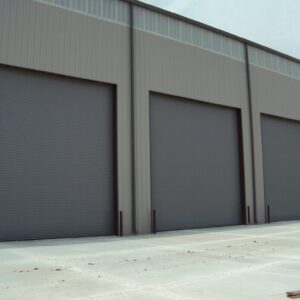
Rolling steel doors provide secure access without requiring tracks to extend across the ceiling. When opened, the interlocking curtain coils compactly above the opening, leaving surrounding ceiling space available for lighting, HVAC, conduit, sprinklers, and other building systems.
Depending on the model and application, rolling steel doors may be available with:
- Galvanized steel, stainless steel, or aluminum construction
- Insulated or non-insulated slats
- Manual or motorized operation
- High-cycle configurations
- Fire-rated assemblies
- Security and access-control options
- Powder-coated finishes
- Wind-load configurations
- Counter-height or full-height designs
Door materials, dimensions, ratings, and operating features vary by manufacturer and model. Barron can help identify the appropriate configuration based on the opening and facility requirements.
Types of Rolling Steel Doors
Insulated Rolling Steel Doors
Insulated rolling doors use filled slats to improve thermal performance and environmental separation. Depending on the model, the slats may contain foam or mineral wool insulation.
These doors may be considered for warehouses, manufacturing facilities, storage areas, and other openings where temperature control is important. Models documented in the analysis offer insulation values ranging from R-4.7 to R-7.2. Confirm the current R-value and U-factor for the selected model before publication or purchase.
Rapid Roll and Coiling Steel Doors
Rapid roll and high-performance coiling steel doors are designed to operate faster and cycle more frequently than standard service doors. They may be appropriate for busy entrances where frequent vehicle or equipment traffic requires faster access.
High-performance models can offer substantially higher cycle ratings than standard rolling doors. The required cycle life should be calculated according to expected daily use rather than speed alone.
Roll-Up Service Doors
Roll-up service doors are versatile, full-height rolling doors used in commercial and industrial facilities. They are available in galvanized steel, stainless steel, and aluminum, with manual and motorized operating options.
Standard configurations may accommodate openings up to 30 feet wide by 30 feet high, with custom sizes available for specialized applications. Final dimensions must be confirmed for the selected product.
Rolling Counter Doors and Shutters
Rolling counter doors are compact coiling doors designed to secure smaller service openings. Common applications include cafeterias, concession stands, healthcare facilities, pharmacies, parts counters, ticket booths, mall kiosks, and other customer-service areas.
Fire-rated counter-door configurations are also available for qualifying openings.
Rolling Sheet Doors
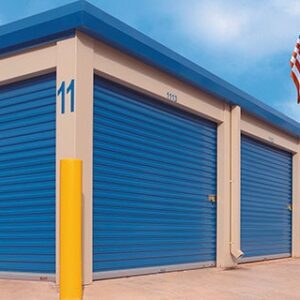
Rolling sheet doors use formed sheet-steel curtains rather than individual interlocking service-door slats. They are commonly used for self-storage units, mini-warehouses, and light industrial openings where security, durability, and efficient operation are priorities.
Their design can provide a practical solution for facilities with many similarly sized openings.
Compare Rolling Steel Door Types
| Door Type | Best Suited For | Primary Benefit | Important Consideration |
| Insulated Rolling Steel Doors | Temperature-controlled commercial and industrial openings | Thermal performance and environmental separation | Confirm the model-specific R-value and U-factor |
| Rapid Roll and Coiling Steel Doors | High-cycle facility entrances | Faster operation for frequent traffic | Calculate the required cycle rating for actual daily use |
| Roll-Up Service Doors | Warehouses, manufacturing facilities, and commercial openings | Versatile full-height security | Confirm material, slat gauge, operator, and opening dimensions |
| Rolling Counter Doors and Shutters | Cafeterias, pharmacies, service counters, and concession stands | Compact security for smaller openings | Determine whether a fire-rated assembly is required |
| Rolling Sheet Doors | Self-storage, mini-warehouses, and light industrial buildings | Practical security for repeated openings | Confirm wind-load and duty-cycle requirements |
Rolling Steel Door Applications
Warehouses and Distribution Centers
Rolling steel doors provide secure access for shipping, receiving, storage, and material-handling areas. Motor operators and high-cycle components may be appropriate for openings with frequent daily use.
Manufacturing Facilities
Manufacturing applications may require heavy-duty construction, high-cycle performance, access control, or resistance to demanding operating conditions. The facility’s traffic, security, opening size, and surrounding equipment should guide door selection.
Self-Storage Facilities
Rolling sheet doors provide individual access and security for tenant storage units. Their compact design makes them suitable for facilities containing many repeated openings.
Parking Structures
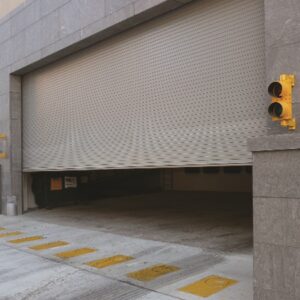
Rolling steel doors and grilles can help control vehicle access to parking garages and secure parking areas. Operator, access-control, visibility, ventilation, and exterior exposure requirements should be evaluated for each facility.
Cafeterias and Concession Stands
Rolling counter doors secure food-service windows, cafeterias, concession areas, parts counters, and ticket booths when closed. Fire-rated configurations may be required when the opening is located in a rated wall.
Retail and Commercial Facilities
Rolling doors can help secure storefronts, service areas, pharmacies, kiosks, and other commercial openings after operating hours.
Food Processing and Commercial Kitchens
Stainless steel options may be considered for corrosive, food-processing, or washdown environments. Required sanitation, finish, and compliance characteristics must be confirmed for the selected model.
Fire-Rated Openings
Rolling fire doors protect openings in fire-separation walls. These doors are code-related assemblies and should not be treated as interchangeable with standard non-rated rolling service doors.
Rolling Steel Doors vs. Sectional Overhead Doors
Rolling steel and sectional doors use different operating mechanisms.
A rolling steel door coils around a barrel above the opening and does not require horizontal tracks across the ceiling. A sectional overhead door consists of hinged panels that travel upward and then along ceiling-mounted tracks.
Consider a Rolling Steel Door When:
- Ceiling space is limited or occupied by building systems
- A compact overhead storage method is needed
- The opening requires a fire-rated assembly
- Security is a leading priority
- The facility requires a high-cycle configuration
- A wide commercial or industrial opening must be secured
Consider a Sectional Door When:
- The building has sufficient track and ceiling clearance
- Higher insulation performance is the primary concern
- The opening is a conventional loading-dock application
- The facility requires a sectional panel configuration
Final selection should account for the opening dimensions, headroom, side clearance, insulation, traffic, security, fire code, and available installation space.
Rolling Steel Fire Doors and NFPA 80
Rolling fire doors are rated assemblies designed for openings in fire-separation walls. Available configurations documented in the analysis include 45-minute, 1½-hour, 3-hour, and 4-hour ratings.
Applicable models may also be evaluated under NFPA 80 and UL 10C requirements. The required rating must be determined from the building plans, wall rating, adopted codes, and authority having jurisdiction.
Annual Inspection and Drop Testing
The supplied gap analysis states that NFPA 80 requires an annual operational test for fire-rated rolling doors. The inspection verifies that the release mechanism operates and the door closes fully at a controlled rate.
The complete assembly should be evaluated, including the curtain, guides, hood, operator, and release components. Inspection records should be maintained according to applicable requirements. Barron’s service team can assist with rolling fire-door inspection and service across its six-state service area.
Publishing note: Confirm Barron’s exact inspection credentials and service scope before adding certification-specific claims.
Materials and Finishes
Rolling doors are available in several materials for different operating environments.
Galvanized Steel
Galvanized steel is commonly used for commercial and industrial rolling doors because it provides durable construction for general applications.
Stainless Steel
Stainless steel may be considered for corrosive, hygienic, food-processing, or washdown environments. The required alloy, finish, and sanitation characteristics should be confirmed for the specific facility.
Aluminum
Aluminum offers a lighter, corrosion-resistant option for certain commercial openings. It may also be selected where appearance or reduced curtain weight is important.
The analysis identifies slat gauges ranging from 18 to 24 across available products. Gauge, profile, material, and finish vary by model and should not be presented as universal specifications.
Operating Options
Rolling steel doors may be configured with:
- Manual push-up operation
- Hand-chain operation
- Hand-crank operation
- Electric motor operators
- Access-control systems
- Remote activation devices
- Safety and sensing equipment
The appropriate operating method depends on the door size, weight, daily cycle count, traffic pattern, accessibility requirements, and facility controls.
How to Choose a Rolling Steel Door
Determine the Door’s Purpose
Start by identifying whether the opening needs general security, insulation, high-cycle performance, counter-level access, fire protection, or a sheet-door solution.
Confirm Whether a Fire Rating Is Required
Review the building plans and code requirements to determine whether the opening is located in a fire-rated wall. A rated opening requires a complete, compatible fire-door assembly.
Estimate Daily Door Cycles
Estimate how often the door will open and close during a normal operating day. Standard and high-performance models carry different cycle ratings, so expected traffic should be considered during selection.
Measure the Opening and Available Clearance
Record the opening width and height, then evaluate the available headroom and side clearance. Rolling doors require space above the opening for the coiled curtain, hood, and operating components.
The analysis provides a general reference of 12 to 18 inches of headroom, but actual clearance requirements vary by door, opening size, operator, and mounting configuration. Use manufacturer drawings for final planning.
Evaluate Insulation Requirements
If the opening separates spaces with different temperatures, compare panel insulation values, perimeter sealing, air leakage, cycle frequency, and the temperature difference between spaces.
Select the Material and Finish
Choose galvanized steel, stainless steel, or aluminum based on the facility’s environmental exposure, corrosion risk, cleaning requirements, security needs, and appearance.
Review Wind and Exterior Exposure
Exterior doors should be evaluated for wind pressure, weather exposure, building location, and applicable code requirements. Wind-load ratings and regional certifications vary by model.
Choose the Operating Method
Select manual or electric operation based on the door’s size, weight, use frequency, traffic, and required integration with facility controls.
Why Barron Equipment?
Barron Equipment is a family-owned Iowa business that has supplied and installed commercial and industrial equipment since 1979.
Customers work with Barron for:
- More than 40 years of industry experience
- Rolling-door selection and application support
- Professional installation and service
- Access to a network of more than 450 manufacturers
- Service throughout Iowa, Illinois, Wisconsin, Minnesota, Missouri, and Nebraska
- Locations in Davenport and Des Moines, Iowa
- Recognition with the 2020 BBB Torch Award for Ethics
Publishing note: Confirm any manufacturer authorization and factory-training language before adding those claims to the live page.
Frequently Asked Questions
What is a rolling steel door?
A rolling steel door is a commercial overhead door made from interlocking metal slats that coil around a barrel above the opening. This compact design does not require ceiling-mounted horizontal tracks.
How is a rolling steel door different from a sectional door?
A rolling steel door coils above the opening. A sectional door uses hinged panels that travel upward and along tracks mounted near the ceiling. Rolling doors leave more overhead space available for other building systems.
What types of rolling steel doors does Barron offer?
Barron’s current category includes insulated rolling steel doors, rapid roll and coiling steel doors, roll-up service doors, rolling counter doors and shutters, and rolling sheet doors.
Are rolling steel doors fire-rated?
Certain rolling steel doors are available as fire-rated assemblies. Standard service and sheet doors should not be assumed to carry a fire rating unless the complete assembly is specifically listed and labeled for that purpose.
What fire ratings are available?
The gap analysis identifies 45-minute, 1½-hour, 3-hour, and 4-hour configurations. The required rating depends on the wall assembly, building plans, adopted codes, and authority having jurisdiction.
Do rolling fire doors require annual inspections?
The supplied analysis states that NFPA 80 requires an annual operational test for fire-rated rolling doors. The test verifies that the release mechanism operates and the door closes properly.
What materials are available?
Rolling doors may be available in galvanized steel, stainless steel, or aluminum. Material availability, slat gauge, finish, and construction vary by manufacturer and model.
Where are rolling steel doors used?
Common applications include warehouses, distribution centers, manufacturing facilities, self-storage properties, parking structures, retail storefronts, cafeterias, concession stands, and fire-rated wall openings.
What sizes are available?
The analysis identifies standard roll-up service-door configurations up to 30 feet wide by 30 feet high, with custom sizes available. Maximum dimensions must be confirmed for the selected model.
Where does Barron install rolling steel doors?
Barron Equipment provides rolling steel door sales, installation, and service throughout Iowa, Illinois, Wisconsin, Minnesota, Missouri, and Nebraska from its Davenport and Des Moines locations.
Rolling Steel Door Installation and Service
The right rolling door depends on the opening, available clearance, traffic, security requirements, operating environment, and applicable building codes.
Barron’s process includes:
- Application review: Discuss the opening and performance requirements.
- Site evaluation: Complete field measurements when required.
- Product selection: Compare applicable door types, materials, ratings, and operators.
- Project quote: Prepare a recommendation and customized quote.
- Installation and service: Coordinate installation and provide ongoing support.
Request a Rolling Steel Door Quote
Secure your facility with a rolling steel door selected for the opening, operating environment, and performance requirements.