
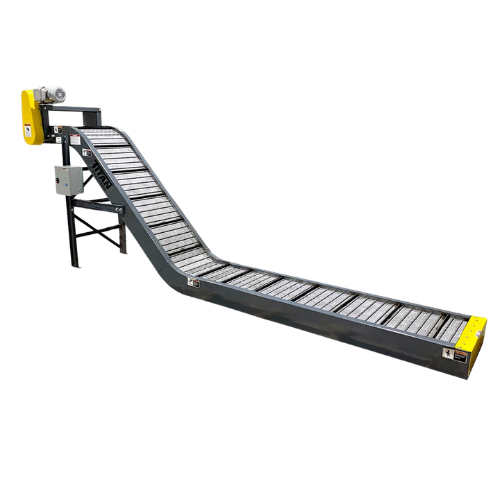
Low Profile Scrap Conveyor for Machine-Tool Applications
Not every metalworking cell has room for a full-depth chip conveyor. When floor space is tight or the machine discharge point sits low, the Titan Model 620 delivers reliable scrap removal in a compact 7-inch deep frame. This low profile hinged steel belt conveyor is purpose-built for CNC machining centers, lathes, stamping presses, and other metalworking equipment where standard-depth conveyors create clearance problems.
Titan Industries has designed the Model 620 around the same interlocking steel apron belt construction used across their heavy-duty conveyor line, but packaged in a formed 10-gauge steel frame that fits into spaces where competing conveyors cannot. The result is full scrap-handling capability without compromising on the footprint your machines and operators need.
Construction and Belt Design
The Model 620 uses a 2½” pitch hinged steel belt—the same proven interlocking apron design that handles metal chips, turnings, stampings, small parts, and process scrap in wet, dry, oily, and high-temperature environments. Belt widths range from 6 inches to 36 inches, covering everything from compact lathe installations to wide stamping press discharge applications.
Belt styles are available in plain, perforated, or pimpled aprons to match the application. Plain aprons are standard for general chip removal. Perforated aprons allow coolant to drain back to the machine sump. Pimpled (dimpled) aprons provide additional grip for steep inclines or oily scrap that tends to slide.
The frame is formed from 10-gauge steel and finished with one coat of industrial enamel. Grease-sealed bearings on the drive end reduce maintenance intervals, and 5-tooth sprockets with a 4.25″ pitch diameter provide positive belt engagement throughout the conveyor’s operating speed range of 5 to 50 FPM.
Titan Radial Sidewing Technology
One of the most common problems with hinged steel belt conveyors is chip jamming between the belt apron and the sidewing. Titan addresses this with two sidewing options on the Model 620. Standard stamped low profile sidewings are available for general applications, but the real differentiator is Titan’s exclusive Radial Sidewing. This design virtually eliminates any gap between the sidewing and the apron, significantly reducing the chip jamming that causes downtime, belt damage, and maintenance calls in metalworking environments.
For operations running multiple shifts or processing materials that produce fine, stringy chips—common with aluminum, stainless steel, and certain alloys—the Radial Sidewing option can make a measurable difference in conveyor uptime.
Drive, Incline, and Support Options
The standard Model 620 ships with a top mount drive, ½ HP motor (230/460V, 3-phase, 60 Hz), structural channel supports, and a factory-set speed of 30 FPM. Speeds are configurable from 5 to 50 FPM depending on the application, chip type, and discharge requirements.
Incline options include 30, 45, and 60 degree configurations, allowing the conveyor to elevate scrap from below-floor machine sumps or ground-level discharge points into collection bins, hoppers, or secondary transport conveyors. Smaller units can be specified with optional 3-bolt flange bearings, while larger units offer T-slot bearings for simplified installation and alignment.
Additional options available from Titan include bottom mount and side mount drive configurations, bulb infeeds, micro-adjustable supports, casters for portable applications, top covers, special discharge chutes, drain plugs, fixed side rails, flared side rails, E-stop controls, photo eyes, 24V DC zero-speed switches, expanded metal guard covers, plexiglass chain guard covers, oilers, and custom paint colors.
Where the Model 620 Fits in the Titan Lineup
Titan’s hinged steel belt conveyor family spans five models with belt pitches from 2½” to 6″. The Model 620 sits in the low profile, medium-duty range. Here’s how it compares to its siblings:
The Model 610 shares the same 2½” pitch but uses a heavier 12-gauge frame for more demanding structural requirements. The Model 630 also uses a 2½” pitch with a 10-gauge frame but features a larger 6-tooth sprocket and 5″ pitch diameter for higher-capacity applications. The Model 640 steps up to a 4″ belt pitch, and the Model 660 uses a 6″ pitch for the heaviest scrap loads.
If your application calls for a compact frame and moderate chip volume, the 620 is typically the right starting point. If you need heavier frame construction at the same pitch, look at the 610. If chip size or volume exceeds what a 2½” pitch can handle, the 640 or 660 may be more appropriate.