
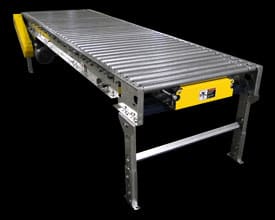
Friction Drive Roller Conveyor with Built-In Accumulation Capability
Most powered roller conveyors use either chain, O-rings, or motorized rollers to drive individual rollers in the bed. Belt driven live roller conveyors take a different approach — a flat belt runs along the underside of the conveyor bed, and the bed rollers sit on top of the belt. Friction between the belt surface and each roller drives the roller forward. When a product stops on the conveyor (because of a downstream blockage, gate, or manual hold), the belt continues to move but the rollers underneath the stopped product slip against the belt instead of forcing the product forward. This natural slippage is what makes BDLR conveyors one of the most economical ways to achieve accumulation without zone controls, sensors, or pneumatic components.
How BDLR Accumulation Works
In a BDLR system, the belt provides a constant driving force to every roller in the bed. When the conveyor is clear, products ride on the powered rollers and move at belt speed. When a product reaches a stop point — a gate, an end stop, or another product — the rollers beneath it stop turning because the friction between the product and the roller exceeds the friction between the belt and the roller. The belt slides harmlessly underneath. Upstream products continue moving until they contact the stopped product, then their rollers stop as well. This creates a line of accumulated products with minimal contact pressure between them.
This accumulation method is called minimum pressure accumulation. It does not require photoeyes, zone cards, or independent motor control. The friction relationship between the belt, rollers, and products handles it mechanically.
Straight Sections and Curve Sections
On straight BDLR sections, the flat drive belt contacts the underside of cylindrical bed rollers. The belt is typically a PVC or polyurethane material running on drive and idler pulleys at each end of the conveyor section. On curve sections, a V-belt replaces the flat belt and drives tapered bed rollers. The tapered rollers compensate for the different path lengths on the inside and outside of the curve, keeping products tracking straight through the turn — just as they do in other tapered-roller curve designs.
When to Choose BDLR Over Other Powered Roller Systems
BDLR conveyors occupy a specific niche between gravity conveyors (no power, no accumulation control) and 24V MDR systems (full zone control, higher cost). Choose BDLR when the application requires powered transport with accumulation but does not need the precision of independent zone control or zero-pressure singulation. BDLR is well suited for operations where products can tolerate light contact during accumulation and where the priority is reliable, low-maintenance powered movement at an economical price point.
For applications where products must never touch during accumulation — fragile cartons, labeled products, or barcode-sensitive items — a 24V MDR system with photoeye-actuated zone control is the better choice. For heavy loads requiring positive mechanical drive, chain driven live roller (CDLR) conveyors provide the grip that friction-based BDLR cannot.
Typical Specifications
- Rollers: 1.9 in. diameter, 16 ga. galvanized (standard)
- Roller Centers: 3 in. (standard)
- Drive Belt: PVC or polyurethane flat belt (straights); V-belt (curves)
- Speed: 60 FPM typical (variable speed available)
- Drive: Center drive standard; end drive available
- Frame: 10 ga. formed steel channel
- Widths: 12 in. to 42 in. between rails (application-specific widths available)
- Motor: 1/2 HP, 220/3/60 standard (higher HP available)
Final specifications depend on the manufacturer, product weight, conveyor length, accumulation requirements, and system layout.
Applications
BDLR conveyors are commonly used in distribution center carton transport and accumulation, order fulfillment staging areas, packaging line infeed and outfeed, manufacturing assembly line buffering, shipping and receiving operations, and any application where boxes or packages must be transported and held in queue without requiring independent zone control.
Selection Assistance from Barron Equipment
Selecting the right powered roller technology depends on product type, weight, accumulation requirements, speed, and how the conveyor integrates with upstream and downstream equipment. Barron Equipment helps facilities across Iowa and the Midwest evaluate BDLR, MDR, CDLR, and belt conveyor options and design the right system for the application.