
FIND US
Davenport, IA
4710 N Brady St
Davenport, IA 52806
Des Moines, IA
2276 NE 46th Ave
Des Moines, IA 50317
Wall-Mounted Jib Cranes
What Is a Wall Mounted Jib Crane?
When floor space is limited but lifting capacity isn’t negotiable, a wall mounted jib crane delivers localized material handling without occupying valuable square footage. Unlike freestanding systems that require a dedicated floor footprint, these cranes anchor directly to a wall or structural column — keeping your work area open and your operations moving efficiently.
Wall and column mounted jib cranes are engineered for targeted lifting in manufacturing cells, loading bays, assembly stations, and maintenance areas. They’re a practical choice any time you need controlled, repeatable load positioning within a defined work radius, without the overhead infrastructure of a full bridge crane system.
Barron Equipment offers two distinct configurations: a tie rod supported design and a cantilever design, each suited to different structural and operational requirements.
Types of Wall-Mounted Jib Crane
-
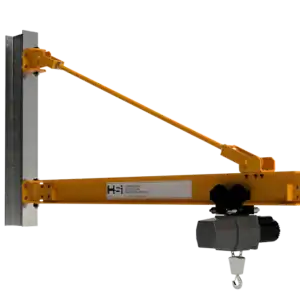
Wall Mounted Jib Crane – 311 Series 250–10,000 lb Capacities
Item ID: 311 JIB CRANESFrom $1,413.13 Select options This product has multiple variants. The options may be chosen on the product page -
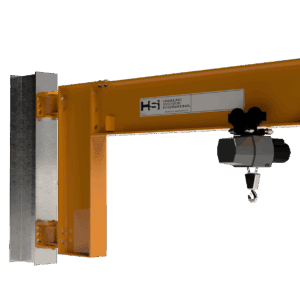
Cantilever Jib Crane – 313 Series 250-10,000 lb Capacities
Item ID: 313 JIB CRANESFrom $1,740.46 Select options This product has multiple variants. The options may be chosen on the product page
Features and Benefits
The two styles available in this category serve the same fundamental purpose but perform differently depending on how you need the hoist to travel and how the crane attaches to the structure.
The 311 Series tie rod style uses an angular support rod extending from the upper wall mounting point to the outer end of the boom. This configuration reduces boom deflection under load and adds structural rigidity, making it a cost-effective and reliable solution for most general-purpose lifting applications. The hoist and trolley can travel most of the boom length, with the tie rod occupying the upper clearance zone.
The 313 Series cantilever style eliminates the tie rod entirely, relying instead on two flush wall-mounted brackets to support the boom. This opens the full height above and below the boom for unrestricted hoist travel from end to end — an advantage in applications where clearance above the boom matters or where overhead obstructions would interfere with a tie rod. The cantilever design also provides a cleaner installation profile in facilities where headroom is at a premium.
Both series support capacities from 250 lb up to 10,000 lb with multiple span options, and both are compatible with manual or powered hoists and trolleys.
Applications
Wall and column mounted jib cranes excel in environments where lifting needs are concentrated in a defined zone and floor-mounted alternatives aren’t practical. Both the 311 and 313 Series are well suited to:
Manufacturing and fabrication workstations where parts need to be lifted, rotated, or transferred between fixtures without interrupting adjacent workflows. Assembly and maintenance operations where technicians handle sub-assemblies or equipment that would otherwise require manual team lifting. Loading and unloading zones where materials move from floor level to truck height on a repetitive basis. Areas operating beneath an existing overhead crane system, where a wall mounted crane provides supplemental coverage in zones the bridge system can’t reach. Facilities with limited or no available floor space for freestanding crane columns.
Because these cranes mount to existing structural walls or columns, they’re often faster and more economical to commission than floor-mounted alternatives — particularly in facilities where poured concrete foundations aren’t an option.
Selection Assistance
Choosing between the 311 and 313 Series — and selecting the right capacity and span — depends on several factors specific to your facility and application.
Lifting capacity is the starting point. Identify the maximum load weight you’ll need to handle, including any attached lifting hardware, and select a capacity rating above that threshold to allow for a safe working margin. Both series are available from 250 lb through 10,000 lb.
Span length determines how far the boom reaches from the mounting point. Measure the distance from the wall face to the furthest point where loads need to be lifted or placed. Barron Equipment carries multiple span options for each series.
Mounting location and structural support are critical. The wall or column must be capable of handling the applied loads. Column mounting is frequently preferred when structural steel or reinforced concrete columns are present. If structural capacity is uncertain, a structural assessment should be completed before installation.
Available headroom affects hoist selection and affects which boom style is appropriate. In tight headroom environments, the cantilever design’s unobstructed boom clearance may offer an advantage.
Duty cycle and frequency of use will influence hoist type — manual chain hoists are well suited to lighter or less frequent lifts, while electric hoists improve productivity in high-cycle applications.
Barron Equipment’s application specialists can help you evaluate your specific requirements and recommend the right configuration for your facility. Contact us using the LiveChat or fill out the form below and our team will reach out to you shortly.