
FIND US
Davenport, IA
4710 N Brady St
Davenport, IA 52806
Des Moines, IA
2276 NE 46th Ave
Des Moines, IA 50317
Belt Transfer Conveyors
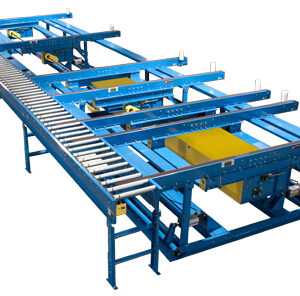
Belt transfer conveyors are specialty material-handling systems designed to move products between conveyor sections, redirect loads at 90-degree angles, or bridge gaps where standard conveyors are not suitable. Unlike a traditional conveyor with one continuous belt, these systems use multiple parallel belt strands to support and reposition products while maintaining their orientation within the line.
Barron Equipment offers multi-strand belt transfer conveyors from Roach Conveyors for metal fabrication, manufacturing, assembly, distribution, and industrial-processing applications.

How Belt Transfer Conveyors Work
A belt transfer conveyor moves a product from one conveyor path to another without requiring manual handling. Although operation varies by model, a typical transfer sequence includes:
- The product enters the transfer position.
- Stops or controls position the load.
- Multiple belt strands raise or engage the product.
- The belts move the load across or perpendicular to the original conveyor path.
- The transfer lowers or clears after the movement is complete.
This type of system is commonly integrated with line-shaft, live-roller, and other powered conveyors.
Belt Transfer Conveyor Configurations
7 Strand Belt Transfer
The 7 Strand Belt Transfer is designed for long steel flats, machined metal components, and other products requiring controlled movement without surface damage. It uses seven parallel, 2-inch-wide nitrile roughtop belts and UHMW polyethylene product stops to position loads during transfer.
The confirmed configuration supports loads up to 150 pounds and products up to 32 feet long. It is designed to move steel flats from a line-shaft conveyor into the next stage of a manufacturing process.
10-Strand 90° Belt Transfer
The 10-Strand 90° Belt Transfer redirects products at a right angle within a conveyor system. It uses a pivot-type lift that raises ten belt strands above the primary conveyor surface, transfers the load perpendicular to its original direction, and then lowers back into position.
The confirmed configuration integrates with a Model 196LR belt-driven live-roller conveyor and supports strand centerlines from 12 to 48 inches. It is designed for products over 6 feet long and uses 2-inch-wide, three-ply Poly #135 nitrile roughtop belts.
Product Comparison
| Feature | 7 Strand Belt Transfer | 10-Strand 90° Belt Transfer |
|---|---|---|
| Primary Function | Long-product transfer | 90-degree direction change |
| Number of Strands | 7 | 10 |
| Belt Type | 2″ nitrile roughtop | 2″ three-ply Poly #135 nitrile roughtop |
| Confirmed Capacity | Up to 150 lbs | Verify for final configuration |
| Product Length | Up to 32 ft | Over 6 ft |
| Connected Conveyor | Line-shaft conveyor | Model 196LR belt-driven live roller |
| Positioning Feature | UHMW product stops | Pivot-type lift |
| Strand Spacing | Varies by design | 12″–48″ centerlines |
Why Use Nitrile Roughtop Belts?
A nitrile roughtop belt has a textured, high-friction surface that helps grip products during transfer. Nitrile also resists oil and grease, making it appropriate for machined parts and metal components that may carry cutting fluid or residual oil.
Both confirmed belt-transfer products use 2-inch-wide nitrile roughtop belts. On the 7 Strand Belt Transfer, the belts help move steel flats without scratching the product surface.
What Are UHMW Product Stops?
UHMW product stops are positioning components made from ultra-high-molecular-weight polyethylene. This durable, low-friction material helps stop and position products without marking sensitive metal surfaces.
The 7 Strand Belt Transfer uses UHMW stops to position steel flats during the transfer sequence.
Belt Transfer vs. Other Transfer Types
Different transfer technologies serve different load types and capacities.
| Transfer Type | Best For | Confirmed Capacity |
|---|---|---|
| Belt Transfer | Metal parts and surface-sensitive products | Up to 150 lbs on the 7-strand configuration |
| V-Belt Transfer | Cartons, totes and delicate surfaces | Up to 500 lbs |
| Chain Transfer | Pallets, crates and rigid unit loads | Up to 3,000 lbs |
| Wheel Transfer | Mixed product sizes and right-angle transfers | Varies by model |
Common Applications
Belt transfer conveyors are commonly used for:
- Steel-flat handling
- Machined metal components
- Long products with varying lengths
- Right-angle conveyor transfers
- Manufacturing-line integration
- Surface-sensitive material movement
- Product reorientation
- Applications where a wide conveyor curve is impractical
The systems are particularly relevant to metal fabrication, automotive production, manufacturing, assembly, distribution, packaging, and industrial-processing operations.
Information Needed for a Quote
Belt transfer conveyors are configured around the product and surrounding conveyor system. Before requesting a quote, gather:
- Product length, width, and height
- Maximum product weight
- Required transfer direction
- Transfer distance
- Upstream conveyor type
- Downstream conveyor type
- Desired operating speed
- Product-bottom material
- Surface-protection requirements
- Available footprint
- Control and automation requirements
Providing this information helps determine the number of strands, belt material, spacing, lift method, and conveyor integration requirements.
Frequently Asked Questions
What is a belt transfer conveyor?
A belt transfer conveyor uses multiple parallel belt strands to move products between conveyor sections, change the direction of travel, or bridge gaps while maintaining product orientation and spacing.
What is a 90-degree belt transfer conveyor?
A 90-degree belt transfer redirects products at a right angle without manual handling. The transfer raises the belt strands above the primary conveyor surface, moves the load perpendicular to its original direction, and then returns to its lowered position.
What is a nitrile roughtop belt?
A nitrile roughtop belt is an oil-resistant conveyor belt with a textured surface that provides grip while helping protect the product. It is commonly used for machined metal parts and other surface-sensitive loads.
What information is needed for a belt-transfer quote?
Provide the product dimensions and weight, required direction change, transfer distance, connected conveyor types, operating speed, and any surface-protection requirements.
Belt Transfer Conveyor Selection and Installation
Barron Equipment has supplied material-handling solutions since 1979 and provides belt transfer conveyor planning, installation, and service support. Barron Equipment serves all of Iowa and Illinois, plus parts of Wisconsin, Minnesota, Missouri, and Nebraska.
Request a quote online to discuss the right belt-transfer configuration for your application.