
FIND US
Davenport, IA
4710 N Brady St
Davenport, IA 52806
Des Moines, IA
2276 NE 46th Ave
Des Moines, IA 50317
Cantilever Racking
Cantilever racking is an open-front storage system designed for long, bulky, or irregularly shaped materials that do not fit easily on standard pallet rack. Instead of using vertical front posts, horizontal arms extend from upright columns to provide unobstructed access to lumber, pipe, tubing, sheet goods, steel bars, carpet rolls, and similar materials.
Barron Equipment offers light-duty, intermediate-duty, and heavy-duty cantilever racking for warehouses, manufacturing facilities, building-material suppliers, and other industrial operations. Systems are available in single-sided and double-sided configurations, with different arm styles, capacities, heights, and construction types to fit your storage requirements.
-

Cantilever Racking – Single or Double Sided Upright – Starter Kit – 12 ft. or 16 ft. Tall
Item ID: MCRSKFrom $693.90 Select options This product has multiple variants. The options may be chosen on the product page -

Intermediate Duty Cantilever
Read more -
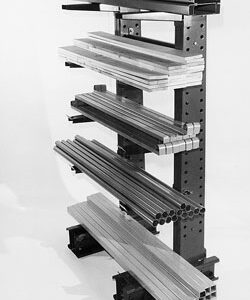
Light Duty Cantilever Racking
Read more -

MECO OMAHA Cantilever Rack
Read more
Product Overview Video
Benefits of Cantilever Racking
Cantilever racking keeps long materials organized, accessible, and off the floor. The open-front design makes it easier to load and retrieve materials using a forklift, side loader, or manual handling method.
A properly designed system can help your facility:
- Improve access to long and oversized materials
- Use vertical storage space more efficiently
- Reduce clutter in aisles and production areas
- Organize materials by size, type, or application
- Expand storage capacity as inventory needs change
- Reduce unnecessary material handling
Light-, Intermediate-, and Heavy-Duty Systems
The right cantilever rack depends on the weight, size, shape, and quantity of the materials being stored.
Light-duty cantilever racking is suited for smaller, lighter materials that require organized horizontal storage.
Intermediate-duty cantilever racking provides greater capacity for applications that fall between light commercial storage and heavy industrial use.
Heavy-duty structural cantilever racking is designed for demanding applications such as lumber, steel, pipe, tubing, and other high-capacity materials.
Never select a rack based only on general labels such as light, intermediate, or heavy duty. The arms, uprights, bases, and braces must be sized for the maximum anticipated load and the intended rack configuration.
Structural vs. Roll-Formed Cantilever Rack
Cantilever rack systems are commonly constructed from either structural or roll-formed steel. The best option depends on the load capacity, environment, reconfiguration needs, and expected level of equipment traffic.
Structural cantilever rack is manufactured from hot-rolled structural steel and typically uses bolted arm connections. It is well suited for heavy loads, permanent installations, outdoor applications, and areas with frequent forklift activity. Hot-dip galvanized configurations may be available for outdoor storage.
Roll-formed cantilever rack is manufactured from cold-formed steel and commonly uses adjustable, clip-in arm connections. It is generally suited for light- to medium-duty indoor applications where arm levels may need to be repositioned as inventory changes.
Structural and roll-formed components are not interchangeable. Arms, uprights, bases, and connection hardware should always be used as part of the system for which they were engineered.
Structural Cantilever Rack
- Heavy-duty construction
- Bolted arm connections
- Suitable for high-capacity applications
- Often selected for permanent layouts
- Outdoor galvanized options may be available
- Well suited for demanding industrial environments
Roll-Formed Cantilever Rack
- Light- to medium-duty construction
- Adjustable clip-in arms
- Easier arm-level reconfiguration
- Primarily designed for indoor applications
- Well suited for operations with changing storage needs
Straight, Inclined, and Axle Arms
Cantilever rack arms are available in several styles to support different materials.
Straight arms create a flat storage surface for stable materials such as lumber, plywood, sheet goods, and steel bar stock.
Inclined arms angle upward to help contain round materials such as pipe, conduit, tubing, and cylindrical stock. Arm lips or stops can provide additional protection against materials rolling off the ends.
Axle-style arms can be used for rolled materials such as carpet, fabric, wrapping, or other products that need to rotate during retrieval or dispensing.
Arm style should be selected according to the material’s shape, dimensions, weight, and handling requirements.
Starter Units and Adder Units
A cantilever rack row begins with a starter unit and can be expanded using adder units.
A starter unit is a complete, self-contained rack section. It typically includes two upright columns, two bases, and the required brace sets, allowing it to stand as an independent storage bay.
An adder unit, sometimes called an add-on unit, extends an existing row. It typically includes one upright, one base, and the necessary braces because it shares an upright with the adjoining rack section.
For longer rows, begin with one starter unit and add an adder unit for each additional bay.
Single-Sided vs. Double-Sided Cantilever Racking
Single-sided cantilever rack has arms on one side of the upright and is commonly positioned along a wall or at the perimeter of a storage area.
Double-sided cantilever rack provides storage on both sides and is generally placed in an open floor area where materials can be accessed from either direction.
Do not mount arms on the back of an upright engineered only for single-sided use. The base, upright, bracing, and anchoring requirements must match the intended configuration.
How to Size a Cantilever Rack System
Selecting the right system begins with the materials you plan to store. Important specifications include arm length, arm capacity, upright height, number of storage levels, and the overall rack configuration.
Material Dimensions
Measure the depth, length, and height of the largest materials the rack will hold. Arm length should adequately support the material without being unnecessarily long.
Maximum Material Weight
Size the system for the heaviest load that could be placed on it, not the average load. Account for the weight supported by each arm as well as the total load applied to the upright.
Upright Height
Choose an upright height that provides the necessary storage levels while maintaining clearance from ceilings, sprinklers, building structures, lighting, and other overhead obstructions.
Arm Quantity and Spacing
The number and spacing of arms depend on the length, stiffness, and weight of the material. Flexible materials may require additional support points to prevent bending or deflection.
Facility Layout
Consider aisle width, material-handling equipment, turning clearance, floor conditions, and access from one or both sides of the rack.
Barron Equipment can help evaluate these factors and develop a cantilever racking configuration suited to your materials, space, and handling process.
Cantilever Rack Safety and Inspection
Cantilever racking must be properly designed, installed, anchored, loaded, and maintained. The system should follow the manufacturer’s engineering documentation, applicable workplace requirements, and the standards associated with industrial steel cantilever storage racks.
Important safety considerations include:
- Anchoring every upright according to the manufacturer’s specifications
- Posting accurate load-capacity information
- Maintaining adequate material-handling aisles
- Protecting uprights exposed to forklift traffic
- Loading arms evenly and within their rated capacity
- Replacing damaged, bent, or incompatible components
- Inspecting the system following any equipment impact
- Keeping stored materials stable and properly supported
Facilities should visually monitor arms, uprights, braces, anchors, and capacity markings as part of routine rack maintenance. Any bay involved in a forklift or material-handling impact should be removed from service until its condition can be evaluated.
ANSI MH16.3 addresses the design, testing, and use of industrial steel cantilever storage racks. OSHA 29 CFR 1910.176 also addresses the safe handling and storage of materials in industrial facilities. System-specific requirements should be confirmed using the rack manufacturer’s current engineering documentation.
Cantilever Racking from MECO OMAHA
Barron Equipment offers MECO OMAHA cantilever racking for industrial storage applications. Available configurations support a variety of long, bulky, and difficult-to-store materials while allowing the system to be sized around the facility’s capacity, space, and access requirements.
Along with MECO OMAHA systems, Barron offers light-duty and intermediate-duty cantilever rack options for applications that do not require a heavy structural system.
Specialty Cantilever Storage
Some applications require a more specialized design than conventional fixed-arm cantilever racking. Crank-out and roll-out cantilever systems provide retractable storage for long materials and can help improve access where aisle space is limited.
Explore our Customized Racking options for specialty crank-out and roll-out cantilever systems.
Find the Right Cantilever Rack for Your Facility
Choosing cantilever racking involves more than selecting a height or general duty level. Material dimensions, maximum load, arm spacing, rack construction, aisle layout, handling equipment, and future expansion should all be considered.
Barron Equipment helps facilities select cantilever racking that supports safer material storage and more efficient access. We serve customers throughout all of Iowa and Illinois, plus parts of Wisconsin, Minnesota, Missouri, and Nebraska.
Request a quote to start planning your cantilever racking system.
Frequently Asked Questions
What is cantilever racking?
Cantilever racking is an open-front storage system designed for long, bulky, or irregularly shaped materials. Horizontal arms extend from upright columns without vertical front posts, making it easier to load and retrieve lumber, pipe, tubing, sheet goods, bar stock, carpet rolls, and similar materials.
What is the difference between structural and roll-formed cantilever rack?
Structural cantilever rack uses heavier structural steel and bolted arm connections for demanding, high-capacity applications. Roll-formed cantilever rack generally uses lighter cold-formed steel and adjustable clip-in arms, making it suitable for light- to medium-duty indoor applications that require greater flexibility.
What is the difference between a starter unit and an adder unit?
A starter unit is a complete freestanding bay with two uprights, two bases, and the required braces. An adder unit extends an existing rack row and uses one additional upright and base because it shares an upright with the adjoining section.
What is the difference between straight and inclined arms?
Straight arms provide a flat surface for stable materials such as lumber, plywood, and sheet goods. Inclined arms angle upward to help contain round materials such as pipe, conduit, and tubing. Arm lips or stops may provide additional containment.
Does cantilever rack need to be anchored?
Cantilever rack uprights should be anchored to the concrete floor according to the rack manufacturer’s specifications and engineering documentation. Anchor requirements depend on the system, floor conditions, loading, and installation design.
What standard applies to cantilever rack?
ANSI MH16.3 addresses the design, testing, and use of industrial steel cantilever storage racks. Facilities should also consider applicable OSHA material-storage requirements and the rack manufacturer’s system-specific documentation.
Can cantilever racking be installed outdoors?
Structural cantilever racking may be available with a galvanized finish for outdoor storage. Environmental exposure, wind, snow, seismic conditions, anchoring, drainage, corrosion protection, and material stability should all be considered when engineering an outdoor system.
What cantilever racking does Barron Equipment offer?
Barron Equipment offers light-duty, intermediate-duty, and heavy-duty cantilever rack options, including MECO OMAHA systems. Configurations are available for different materials, capacities, layouts, and storage environments.