
FIND US
Davenport, IA
4710 N Brady St
Davenport, IA 52806
Des Moines, IA
2276 NE 46th Ave
Des Moines, IA 50317
Industrial Handrail
Industrial handrails provide fall protection, guide pedestrian traffic, and create safe boundaries around loading docks, mezzanines, platforms, machinery areas, stairs, and rooftop work zones. Under OSHA requirements, guardrail systems used in industrial environments are typically designed around a 42-inch top-rail height and must satisfy specific load and spacing requirements. Barron Equipment offers three Ideal Shield handrail systems: Steel Pipe and Plastic Handrail, Aluminum Handrail, and Roof Shield Rail.
Barron Equipment has served industrial facilities since 1979 and provides handrail solutions throughout Iowa and Illinois, plus parts of Wisconsin, Minnesota, Missouri, and Nebraska.
-

Aluminum Handrail
Item ID: HRI-CLR-L-LT-HTFrom $531.00 Select options This product has multiple variants. The options may be chosen on the product page -

Roof Shield Rail
Read more -
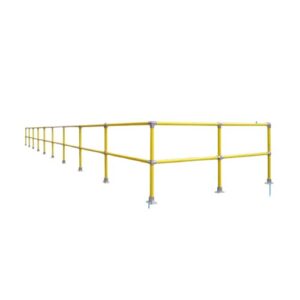
Steel Pipe and Plastic Handrail
Item ID: HRK-CLR-L-LT-HTFrom $415.00 Select options This product has multiple variants. The options may be chosen on the product page
Types of Industrial Handrail
Steel Pipe and Plastic Handrail
The Steel Pipe and Plastic Handrail uses 1¼-inch schedule 40 steel rails and 1¼-inch schedule 80 steel posts sleeved in HDPE plastic. The HDPE covering provides a highly visible finish while eliminating the need for repainting. Standard height is 42 inches, and the system is available in multiple rail configurations, infill options, and gate configurations. Starting at $415.
Aluminum Handrail
The Aluminum Handrail uses 1½-inch schedule 40 and schedule 80 aluminum pipe with a clear anodized or powder-coated finish. It is available in ADA-capable configurations and is often selected for commercial, architectural, and outdoor environments where corrosion resistance and appearance are priorities. Starting at $531.
Roof Shield Rail
The Roof Shield Rail is a modular rooftop fall-protection system designed to protect workers near roof edges and skylights. It uses non-penetrating weighted steel base plates, eliminating the need to penetrate the roof surface. Available in Steel Pipe and Plastic or Aluminum configurations and offered as a request-to-quote system.
Steel Pipe vs. Aluminum Handrail
| Feature | Steel Pipe and Plastic | Aluminum |
|---|---|---|
| Starting Price | $415+ | $531+ |
| Material | Steel pipe with HDPE sleeve | Aluminum pipe |
| Finish | Safety Yellow standard | Clear anodized or powder coated |
| ADA Capable | No | Yes |
| Best For | Industrial and warehouse environments | Commercial, public-facing, and outdoor applications |
| Field Welding | Not required | Not required |
| Lead Time | Approximately 4 weeks | Approximately 4 weeks |
OSHA Requirements for Industrial Handrails
Industrial handrail and guardrail systems are commonly associated with:
- 29 CFR 1910.28(b)(1): Fall protection at exposed edges four feet or more above a lower level
- 29 CFR 1910.29(b)(1): 42-inch top rail height (±3 inches)
- 29 CFR 1910.29(b)(3): 200-pound load requirement
- 29 CFR 1910.29(b)(2): Midrail requirements
- 29 CFR 1910.29(f)(4): Graspability requirements for handrails
Specific compliance depends on the installation, application, and workplace conditions, not the product alone.
Installation Options
Industrial handrail systems are available with several mounting methods:
- Core-In – Post embedded directly into concrete
- Plate-Mount – Surface-mounted to a steel or aluminum base plate
- Side-Mount – Attached to a wall or structure
- Wall-Mount – Secured directly to vertical surfaces
- Non-Penetrating Base Plate – Weighted rooftop installation that avoids roof penetration
All three product families are designed as modular systems and do not require field welding.
ADA-Capable Handrail Configurations
The Aluminum Handrail can be configured for ADA applications. ADA handrails typically require:
- Mounting heights between 34 and 38 inches
- A continuous gripping surface
- A graspable circular profile
Because project requirements vary, ADA suitability should be evaluated for the final configuration rather than assumed across all aluminum systems.
Common Applications
Industrial handrails are commonly used for:
- Loading dock edges
- Mezzanine protection
- Elevated platforms
- Stairways and ramps
- Machinery separation
- Pedestrian walkways
- Rooftop edge protection
- Skylight protection
Facilities often combine handrail systems with dock gates, guardrails, bollards, and other safety barriers as part of a comprehensive safety strategy.
Frequently Asked Questions
What is an industrial handrail?
An industrial handrail is a modular barrier system used to provide fall protection, guide pedestrian traffic, and protect elevated work areas.
What is the difference between a handrail and a guardrail?
A handrail provides graspable support for stairs and ramps, while a guardrail is designed to prevent falls from elevated surfaces. Industrial systems may serve one or both functions depending on the application.
Which OSHA standards apply?
The analysis identifies OSHA 29 CFR 1910.28 and 1910.29 as the primary regulations associated with industrial handrails and guardrails.
What is the difference between Steel Pipe and Plastic Handrail and Aluminum Handrail?
Steel Pipe and Plastic Handrail is intended for industrial environments and uses HDPE-sleeved steel pipe. Aluminum Handrail uses aluminum pipe and can be configured for ADA applications.
What is Roof Shield Rail?
Roof Shield Rail is a non-penetrating rooftop fall-protection system designed to protect roof edges and skylight areas.
Does Barron Equipment install industrial handrail systems?
Yes. Barron Equipment provides installation support through The Docktors service team across Iowa and Illinois, plus parts of Wisconsin, Minnesota, Missouri, and Nebraska.
Industrial Handrail Selection & Installation
Barron Equipment helps warehouses, manufacturers, distribution centers, commercial facilities, and rooftop contractors evaluate industrial handrails based on application, OSHA requirements, installation method, and facility layout. Request a quote online to discuss the best handrail solution for your project.