
FIND US
Davenport, IA
4710 N Brady St
Davenport, IA 52806
Des Moines, IA
2276 NE 46th Ave
Des Moines, IA 50317
Specialty Conveyors
-

10-Strand 90° Belt Transfer
Read more -

4XLift™ Heavy Duty Material Lift
Read more -
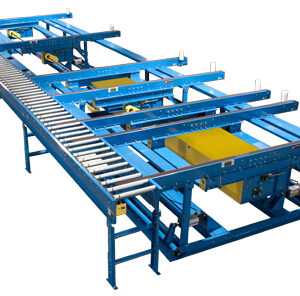
7 Strand Belt Transfer
Read more -
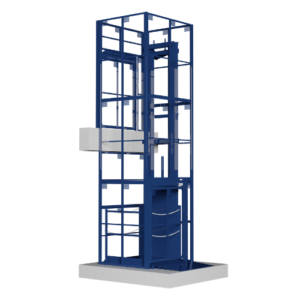
Autoquip FreightLite Hydraulic Freight Lift – Light Duty VRC for Mezzanine Transfer
Read more -
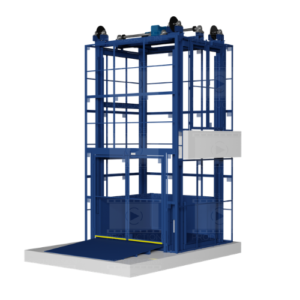
Autoquip Mechanical 4 Post VRC – High Capacity Freight Lift for Multi-Level Transfer
Read more -

Custom Hydraulic Lifts
Read more -

Delta™ VRC Material Lift
Read more -
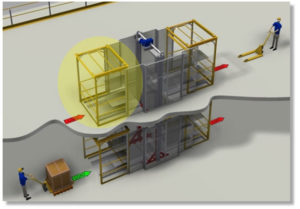
FlexLoader™ Material Conveyor System
Read more -

Hydraulic Cantilever VRC
Read more -

Hydraulic Straddle VRC
Read more -

Hydraulic Vertical Lifts – 21 Series
Read more -

Hydraulic Vertical Lifts – D Series
Read more


What Is a Vertical Reciprocating Conveyor (VRC)?
A Vertical Reciprocating Conveyor (VRC) is a material-only lifting system that raises and lowers loads between two or more levels using a guided carriage. VRCs are used in warehouses, manufacturing facilities, distribution centers, mezzanine-storage applications, and automated conveyor systems where materials must move vertically rather than horizontally.
Unlike freight elevators, VRCs are designed exclusively for material handling and are governed by ASME B20.1, the Safety Standard for Conveyors and Related Equipment. They are not intended to transport people.
Types of Specialty Conveyors
Vertical Reciprocating Conveyors (VRCs) & Material Lifts
VRCs are the primary focus of this category and include hydraulic, mechanical, cantilever, straddle, modular, and automated systems from Wildeck, Autoquip, and PFlow Industries.
Common applications include:
- Mezzanine material movement
- Pallet transfer between floors
- Inventory storage access
- Manufacturing process integration
- Conveyor-system elevation changes
Specialty Belt Transfer Conveyors
The category also includes multi-strand belt-transfer conveyors from Roach Conveyors that are designed for:
- 90-degree product transfers
- Conveyor-line intersections
- Product reorientation
- Gap bridging
These systems help redirect products within automated conveyor layouts without manual intervention.
Automated VRC & Conveyor Integration
Some systems combine vertical lifting directly with powered conveyor equipment.
The FlexLoader™ Material Conveyor System is an example of a system designed to integrate vertical movement into an automated material-handling process.
Hydraulic vs. Mechanical VRC
One of the most important decisions buyers make is whether to choose a hydraulic VRC or a mechanical VRC.
| Selection Criteria | Hydraulic VRC | Mechanical VRC |
|---|---|---|
| Actuation Method | Direct-acting hydraulic cylinders | Chain-driven motor and gearbox |
| Typical Application | Light-to-medium-duty transfer | High-cycle and automated transfer |
| Typical Levels | Two-level applications | Two or more levels |
| Initial Investment | Generally lower | Generally higher |
| Maintenance | Generally more frequent | Generally less frequent |
| Automation | Limited application dependent | Well suited for conveyor integration |
| Safety Standard | ASME B20.1 | ASME B20.1 |
Hydraulic, Mechanical, Cantilever & Straddle Designs
Hydraulic VRCs
Hydraulic systems use direct-acting cylinders to move the carriage. These systems are often selected for mezzanine-access and moderate-duty material-transfer applications.
Mechanical VRCs
Mechanical VRCs use chain-driven motors and gearboxes and are typically selected for higher-cycle applications and conveyor integration.
Cantilever VRCs
Cantilever configurations use structural support on one side of the carriage, helping maintain unobstructed access on the remaining sides.
Straddle VRCs
Straddle configurations use structural columns on both sides of the carriage to support larger loads and create additional stability.
Modular VRCs
Modular VRCs provide a more standardized solution for facilities seeking a faster implementation approach compared to fully custom lift systems.
VRC vs. Freight Elevator
A common source of confusion is the difference between a VRC and a freight elevator.
Vertical Reciprocating Conveyor
- Designed for materials only
- Cannot transport personnel
- Governed by ASME B20.1
- Commonly used in warehouses and manufacturing
Freight Elevator
- Designed under a different code framework
- Used in different personnel and freight applications
- Often evaluated when passenger access may also be required
The correct solution depends on the facility, the material being moved, and the intended use of the system.
Manufacturers We Carry
Wildeck
Wildeck offers hydraulic, mechanical, modular, and automated VRC systems, including the Delta™ VRC, 4XLift™, and FlexLoader™ product families.
Autoquip
Autoquip manufactures hydraulic and mechanical freight lifts commonly used for mezzanine access, material handling, and multi-level transfer applications.
PFlow Industries
PFlow specializes in hydraulic VRC systems, including the 21 Series and D Series material lifts for fixed-level transfer applications.
Roach Conveyors
Roach supplies the specialty belt-transfer systems represented within this category, supporting product-direction changes and conveyor integration.
Applications & Industries Served
Specialty conveyors and material lifts are commonly used in:
- Warehouses and distribution centers
- Manufacturing facilities
- Automotive operations
- Food-processing plants
- Retail back-room storage
- Mezzanine-access applications
- Automated conveyor systems
- Material-staging operations
These systems are often selected when forklifts become inefficient, floor space is limited, or materials must move between levels safely and repeatedly.
ASME B20.1 Compliance
All Vertical Reciprocating Conveyors represented in this category are associated with ASME B20.1, the Safety Standard for Conveyors and Related Equipment. This standard addresses the design, installation, operation, and maintenance of conveyor equipment, including material-only vertical reciprocating conveyors.
Proper installation, guarding, maintenance, and operation remain important parts of a safe material-handling system.
Frequently Asked Questions
What is a specialty conveyor?
A specialty conveyor is a material-handling system designed for applications beyond standard horizontal transport, including vertical lifting, multi-level transfer, and specialized product movement.
What is a vertical reciprocating conveyor?
A VRC is a material-only lift that moves loads between fixed elevations using a guided carriage and hydraulic or mechanical actuation.
What is the difference between a hydraulic and mechanical VRC?
Hydraulic systems use cylinders for lifting, while mechanical systems use chain-driven motors and gearboxes. The best choice depends on cycle requirements, number of levels, and automation goals.
Can a VRC transport people?
No. Vertical reciprocating conveyors are designed exclusively for material handling.
What applications are VRCs used for?
Common applications include mezzanine access, pallet transfer, warehouse storage, manufacturing processes, and vertical conveyor integration.
What information is needed for a quote?
Most projects require load weight, platform size, vertical rise, number of levels, cycle frequency, and available installation space.
Specialty Conveyor Selection & Installation
Barron Equipment helps warehouses, manufacturers, food-processing facilities, distribution centers, and industrial operations evaluate specialty conveyors, material lifts, and VRC systems based on load requirements, rise height, levels served, and operational goals.
Request a quote online to discuss the right VRC, freight-lift, or specialty-conveyor solution for your facility.