
Hydraulic vs. Air Powered Dock Levelers: Which Loading Dock Solution Is Right for Your Facility?
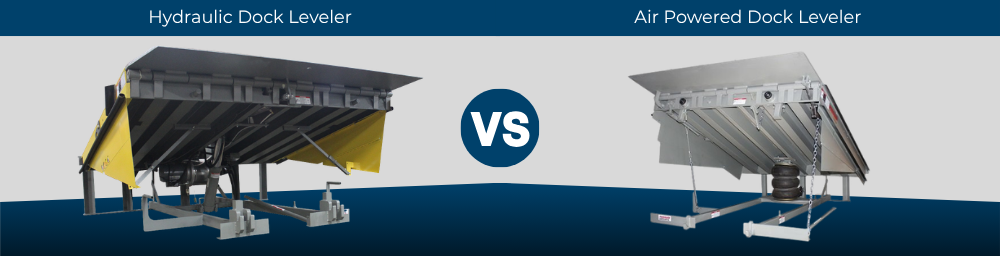
What Is a Hydraulic Dock Leveler?
A hydraulic dock leveler uses hydraulic cylinders, pumps, and motors to raise the deck and extend the lip. These systems are fully powered and activated with a push button, requiring minimal operator effort. Hydraulic dock levelers offer the highest available capacities and are commonly selected for heavy-duty loading dock operations. Key hydraulic dock leveler features include:- Push-button operation
- Fully powered deck and lip control
- High-capacity load handling
- Velocity fuse free-fall protection
- Low operator effort
- OSHA and ANSI MH 30.1 compliant designs
What Is an Air Powered Dock Leveler?
An air powered dock leveler uses compressed air and a bellows system to raise the deck. Rather than hydraulic fluid and cylinders, the unit relies on plant air or a dedicated compressor to lift the platform. Once the operator releases the activation button or lanyard, the leveler lowers and floats to the trailer bed. Air powered dock levelers are often considered a middle ground between mechanical and hydraulic systems because they offer push-button convenience while maintaining a relatively simple operating system. Key air powered dock leveler features include:- Push-button activation
- Compressed air operation
- Fewer moving parts
- Reduced maintenance requirements
- Lower ownership costs
- OSHA and ANSI MH 30.1 compliant construction
Hydraulic vs. Air Powered Dock Levelers: Side-by-Side Comparison
Operation
Hydraulic dock levelers use hydraulic cylinders and pumps to power both the deck and lip movement. Air powered dock levelers use compressed air and a bellows system to raise and position the deck.Winner: Tie
Load Capacity
Hydraulic dock levelers offer the widest capacity range, with models available from 20,000 to 120,000 pounds capacity. This makes them suitable for virtually every loading dock application, from retail distribution to heavy industrial manufacturing. Air powered dock levelers are commonly available in capacities ranging from 25,000 to 50,000 pounds and are designed for standard commercial and industrial loading dock operations.Winner: Hydraulic Dock Levelers
Maintenance
One of the primary advantages of air powered dock levelers is simplicity. Because they contain fewer moving parts than hydraulic systems, maintenance requirements are often reduced. This can contribute to a lower total cost of ownership over time. Hydraulic dock levelers are also designed for long-term reliability but include pumps, motors, cylinders, hoses, and hydraulic fluid that require periodic inspection and service.Winner: Air Powered Dock Levelers
Safety
Both hydraulic and air powered dock levelers are designed to improve loading dock safety and are manufactured to comply with OSHA requirements and ANSI MH 30.1 standards. Hydraulic systems utilize in-line velocity fuses that help prevent uncontrolled platform descent. Air powered systems feature toe guards, safety stops, lockout/tagout provisions, and other built-in safety measures designed to protect operators and maintenance personnel.Winner: Tie
When Should You Choose a Hydraulic Dock Leveler?
A hydraulic dock leveler may be the best choice if your operation:- Handles heavy loads on a regular basis
- Operates a high-volume warehouse or distribution center
- Requires maximum dock throughput
- Utilizes forklifts continuously throughout the day
- Needs capacities beyond standard dock applications
- Prefers fully powered deck and lip operation
When Should You Choose an Air Powered Dock Leveler?
An air powered dock leveler may be the better option if your facility:- Already has compressed air infrastructure
- Wants push-button convenience without a hydraulic system
- Prioritizes reduced maintenance requirements
- Is looking for a cost-effective alternative to hydraulic technology
- Supports typical warehouse and shipping operations
- Wants to minimize electrical consumption at the dock position
Hydraulic vs. Air Powered Dock Levelers: Quick Comparison
| Feature | Hydraulic Dock Levelers | Air Powered Dock Levelers |
|---|---|---|
| Operation | Fully hydraulic cylinders and pump system | Compressed air bellows system |
| Best For | High-volume and heavy-duty facilities | Standard industrial and commercial facilities |
| Maintenance | Low maintenance | Reduced maintenance due to fewer moving parts |
| Activation | Push-button | Push-button |
| Electrical Requirements | Requires hydraulic pump and motor | Uses existing compressed air infrastructure |
| Capacity | Up to 120,000 lbs | Typically up to 50,000 lbs |
| Safety Features | Velocity fuses and hydraulic safety systems | Toe guards, safety stops, lockout features |
Frequently Asked Questions
Are hydraulic dock levelers better than air powered dock levelers?
Not necessarily. Hydraulic dock levelers are often preferred for heavy-duty operations because of their higher capacities and fully powered operation. Air powered dock levelers can provide lower maintenance requirements and may be more economical for standard dock applications.Do air powered dock levelers require compressed air?
Yes. Air powered dock levelers use compressed air and a bellows lifting system. Some facilities use existing plant air, while others may use a dedicated compressor.Which dock leveler requires less maintenance?
Air powered dock levelers typically contain fewer moving parts than hydraulic systems, which can reduce maintenance requirements over the life of the equipment.Are hydraulic dock levelers safer than air powered dock levelers?
Both hydraulic and air powered dock levelers are designed with safety features and comply with OSHA and ANSI standards. The best choice depends on the operational requirements of your facility.Which dock leveler is best for a warehouse?
The right dock leveler depends on loading volume, trailer traffic, capacity requirements, available utilities, and maintenance preferences. High-cycle facilities often choose hydraulic systems, while many standard warehouse applications perform exceptionally well with air powered dock levelers.Choosing the Right Dock Leveler for Your Facility
Both hydraulic and air powered dock levelers offer significant advantages over traditional mechanical systems. Hydraulic dock levelers deliver exceptional performance, high capacities, and fully powered operation for demanding environments. Air powered dock levelers provide push-button convenience, simplified maintenance, and dependable performance for many warehouse and industrial applications. The best solution ultimately depends on your facility’s loading dock traffic, operational demands, maintenance goals, and available infrastructure. Careful evaluation of these factors can help ensure you select the dock leveler that delivers the greatest long-term value for your operation.Cookie Consent
We use cookies to improve your experience on our site. By using our site, you consent to cookies.
Cookie Preferences
Manage your cookie preferences below:
Essential cookies enable basic functions and are necessary for the proper function of the website.
Google Tag Manager simplifies the management of marketing tags on your website without code changes.
CloudFlare provides web performance and security solutions, enhancing site speed and protecting against threats.
Service URL: developers.cloudflare.com (opens in a new window)
Formidable Forms is a powerful WordPress plugin for creating advanced forms and data management solutions.
WooCommerce is a customizable eCommerce platform for building online stores using WordPress.
Statistics cookies collect information anonymously. This information helps us understand how visitors use our website.
Clarity is a web analytics service that tracks and reports website traffic.
Service URL: clarity.microsoft.com (opens in a new window)
SourceBuster is used by WooCommerce for order attribution based on user source.
Google Analytics is a powerful tool that tracks and analyzes website traffic for informed marketing decisions.
Service URL: policies.google.com (opens in a new window)
Marketing cookies are used to follow visitors to websites. The intention is to show ads that are relevant and engaging to the individual user.
CallRail is a call tracking and analytics service. Its script swaps the phone numbers shown on a page and stores the visitor's referrer, landing page and session ID, so phone calls and form submissions can be attributed to the marketing source that brought the visitor to the site.
Service URL: www.callrail.com (opens in a new window)
Google Ads is an online advertising platform that enables businesses to create targeted ads displayed on Google search results and partner sites.
Service URL: policies.google.com (opens in a new window)