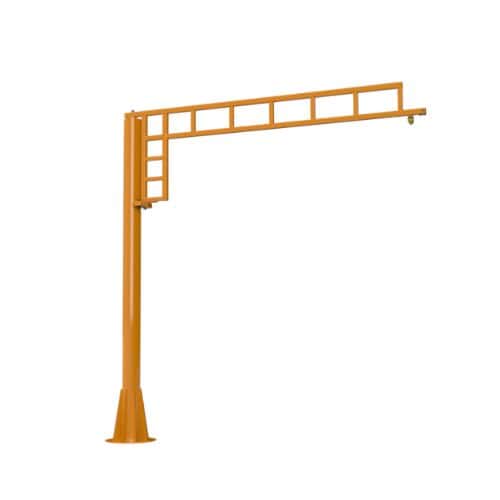
Freestanding jib crane with ladder boom and column-mounted support

Workstation Freestanding Jib Crane – 750F Series – Up To 1000 lbs Capacity

Item ID: 750F JIB CRANES Category

Lead Time: 4 weeks

Freestanding workstation jib crane designed for efficient material handling. Supports smooth rotation and precise positioning. Ideal for assembly cells and workstations. Handles repetitive lifts with improved safety and productivity. 11 Year Warranty

$1,904.13

Overview

A workstation jib crane is about one thing: making repetitive material handling tasks faster, safer, and less taxing on the operator. The HSI 750F is a freestanding workstation jib crane designed to provide all the benefits of a standard freestanding jib crane — with the added advantages of a foundationless mount and the smooth, effortless movement of an enclosed track system. These cranes are ideal for assembly, welding, maintenance, and material handoff between adjacent work areas. A load trolley is included as standard.

With 360° rotation, spans up to 16 feet, and no special concrete footer required, the 750F installs quickly into an existing workstation and begins delivering ergonomic benefits from day one.

Need more capacity or a traditional pillar jib? See the HSI 351 Series for freestanding jib cranes from 500 lbs through 30,000 lbs in standard I-beam configuration.

Enclosed Track — Why It Matters for Workstation Applications

The 750F isn't just a standard freestanding jib crane. Its enclosed track boom is what sets it apart for workstation use.

A traditional I-beam jib crane uses an exposed beam with a bottom-mounted trolley. An enclosed track system encloses the beam within a profile that guides the trolley from inside — delivering several important advantages:

  • Smoother trolley travel — The enclosed track guides the load trolley with less resistance, making it easier for operators to position loads with one hand
  • Ergonomic operation — Reduces fatigue in high-cycle applications like assembly lines and pick-and-place tasks
  • Reduced swing and sway — The enclosed profile creates more stable load movement, improving precision in positioning
  • Cleaner appearance — Better suited to light assembly and workstation environments where debris can accumulate in open beam flanges

This is the defining reason a manufacturing engineer chooses the 750F for a workstation over a standard jib crane of equivalent capacity.

Foundationless Installation — Simple Setup, No Poured Concrete

The 750F requires no special concrete footer. This is the other critical advantage. Standard freestanding jib cranes require a poured foundation — concrete must be poured, set, and cured (up to 28 days) before the crane can be loaded. The 750F eliminates that delay.

The 750F features simple installation, is easy to adjust, and requires no special concrete footer — though the existing floor must meet concrete specifications.

What you need before installation:

  • A concrete floor that meets structural specifications (reinforced concrete with minimum depth — consult a qualified structural engineer)
  • Anchor bolts provided with the crane

What you don't need:

  • A foundation pour
  • Extended curing time
  • Structural modification to the building

This makes the 750F particularly well-suited for facility reconfigurations, new workstation buildouts, and situations where time-to-productivity matters.

Specifications

Specification Detail
Capacity Up to 1/2 ton (1,000 lbs)
Span Up to 16 ft.
Height Up to 16 ft.
Rotation 360° standard
Trolley Load trolley included as standard

Design & compliance standards:

  • All designs meet AISC standards as they pertain to jibs and overhead cranes
  • All cranes are in accordance with OSHA specification 1910.179
  • All design and manufacturing are done in accordance with ANSI specification B30.11
  • All jib and gantry cranes are built to CMAA specification No. 743

Options & Accessories

Available options and accessories include:

  • Tight Wire Kit (Festooning/"Tagline") — for clean cable and hoist power management along the boom
  • Rotation Stops — to limit the rotational travel of the crane arm to a defined work zone
  • Electrical Collectors — for routing power to electric hoists along the enclosed track
  • Parking Device — to lock the boom in a home position when not in use
  • Outdoor Applications — weather protection package
  • Hoist & Trolley Packages — complete system packages with matched hoist and trolley
  • Anchoring Systems — foundation anchoring hardware

Workstation Applications

The 750F is designed for high-cycle, precision-controlled material handling in defined work areas. Common applications include:

  • Assembly lines — Lift and position components repeatedly throughout a shift without fatigue
  • Welding workstations — Maneuver weldments and fixtures within the crane's coverage zone with one-handed control
  • Pick-and-place operations — Smooth, controlled load movement for precise placement onto fixtures, jigs, or conveyors
  • Machine tending — Load and unload CNC machines, presses, or machining centers with consistent repeatability
  • Material handoff between work cells — Swing loads between adjacent workstations without carrying or dragging
  • Maintenance bays — Light assembly and disassembly tasks where a ceiling-mounted or wall-mounted crane isn't available

Configure the Right System

Barron Equipment can help you select the right capacity, span, and hoist package for your application. Fill out the quote form below or contact our team directly.

Product Specification

Span

4 Foot

Weight Capacity

Height Under Boom

8 Foot

FAQs

What is a workstation jib crane?

A workstation jib crane is a freestanding jib crane designed for ergonomic, repetitive use within a defined work cell or workstation. Unlike heavy-duty pillar jib cranes designed for occasional large lifts, workstation jib cranes feature lighter capacities, smooth trolley systems, and designs optimized for operator comfort during repeated use throughout a shift. The 750F is ideal for assembly, welding, maintenance, and material handoff between adjacent work areas.  

What is a foundationless jib crane?

A foundationless jib crane bolts directly to an existing concrete floor rather than requiring a poured concrete foundation. The 750F requires no special concrete footer, though the existing floor must meet concrete specifications. This eliminates the need for foundation pours, extended curing time, and building modifications — making installation significantly faster and less disruptive than traditional freestanding jib cranes.  

What is the difference between the 750F and the 351 Series jib cranes?

The 750F and 351 Series are both freestanding jib cranes but serve completely different purposes. The 750F is a workstation jib crane with an enclosed track boom, optimized for smooth, ergonomic, repetitive operation up to 1,000 lbs in assembly and workstation settings. The 351 Series is a heavy-duty pillar base jib crane using a traditional I-beam boom, designed for capacities from 500 lbs to 30,000 lbs in high-capacity production and maintenance applications. The 750F requires no special concrete footer; the 351 Series requires a poured foundation.

What is an enclosed track jib crane and why is it better for workstations?

An enclosed track jib crane uses a hollow profile beam that guides the load trolley from inside, rather than a traditional exposed I-beam where the trolley rides on the bottom flange. The enclosed track delivers smoother, lower-resistance trolley travel — reducing operator effort in repetitive positioning tasks and making one-handed load control practical. This ease of use is what makes the 750F suited for assembly lines and pick-and-place operations where operators position loads dozens or hundreds of times per shift.  

Does the 750F come with a trolley?

Yes. A load trolley is included as standard with the 750F. This means the crane is ready to accept a hoist and operate immediately upon installation, without needing to separately source a trolley.  

What capacity and span options are available?

The 750F supports capacities up to 1/2 ton (1,000 lbs), spans up to 16 feet, and heights up to 16 feet. Contact Barron Equipment to confirm available configurations and to select the right hoist and trolley package for your specific application.  

What compliance standards does the 750F meet?

The 750F meets AISC standards as they pertain to jibs and overhead cranes, OSHA specification 1910.179, ANSI specification B30.11, and CMAA specification No. 74.  

Safety Information

The following safety information is provided by Handling Systems International, Inc. (HSI). Please read all warnings before installing or operating this equipment.
  • Inspect entire system annually or more frequently as defined by OSHA 1910.179. Inspection must be performed by a qualified person. Failure to do so may cause serious injury or death.
  • This equipment, used as a crane, is not in any way designed for lifting, supporting, or transporting humans. Failure to follow specified load limitations can result in serious bodily injury or death.
  • The rated load of the hoist as marked on the hoist must not exceed the rated capacity of the jib as labeled on the boom. Do not install a hoist with a capacity greater than that of the jib.
  • It is solely the customer’s responsibility to provide suitable mounting supports for the jib crane. HSI recommends that the customer consult a qualified professional architect or engineer in your local area to determine the adequacy of the building support. There should be no deviation from the recommended foundation size or installation recommendations without first consulting a qualified professional. Failure to check this item can result in serious bodily injury or death.
  • Do not impact end stops at speed. Only impact end stops with caution.
  • Never use end stops for repetitive boom impacts.
  • To prevent trolley from running off of the boom, do not operate crane without end stop bolt firmly secured in place on the end of the boom.
  • Do not operate hoist or crane if cotter pins are not in place and properly bent over on both sides of hoist trolley. Check regularly that the cotter pins are in place and securing the hoist on the hoist trolley.
  • Inspect jib for missing or broken parts before operating.
  • Do not adjust or disassemble crane when jib is under load.
  • When moving jib, position the load in the center of the boom.
  • Be certain the load is directly beneath boom before load is lifted. Do not pull sideways on crane.
  • Ensure the load is not attached to the floor and remove any obstacles that impede lifting.
  • Adjustments and/or repairs should be made in an area where it will have the least interference with operation.
  • Never stand under jib when disassembling crane.
 

Resources

View PDF (750F_Installation_Specifications.pdf)

View PDF (750F_OwnersManual-1.pdf)

View PDF (750F_Product_Specifications.pdf)

Request a Quote

Contact Us

Summary

Captcha

Upload PO

NEW PRODUCT: iDOCK 2.0 - DOCK MANAGEMENT SYSTEM