
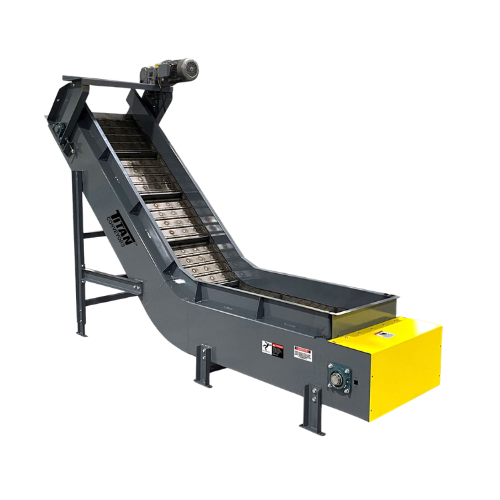
Heavy-Duty Scrap Conveyor for High-Volume Metalworking
Some applications simply produce more scrap than a 2½” pitch conveyor can handle. Large stamping presses, forging hammers, heavy-duty CNC machining centers, die-casting operations, and scrap recycling systems generate chip volumes, part sizes, and impact loads that require a fundamentally heavier belt. The Titan Model 640 answers that demand with a 4″ pitch hinged steel belt, 6,000 lbs of allowable belt pull, and a frame built to withstand the most punishing industrial environments.
Where the 2½” pitch models in Titan’s lineup serve moderate chip loads and tighter spaces, the Model 640 is the conveyor you specify when the application requires maximum chain pull, wider belt capacity, and the structural mass to handle heavy stampings, large turnings, die-cast sprues, and bulky process scrap without compromise.
Heavy-Duty Belt and Chain Pull Capacity
The Model 640 uses a 4″ pitch hinged steel belt with a 10-gauge apron and 3″ high x 7-gauge stamped sidewings—a Titan-exclusive feature that provides additional volume capacity compared to the standard 1½” sidewings on the 2½” pitch models. The belt rides on 2″ diameter cast iron flanged rollers, a significant upgrade from the lighter roller designs used in the Model 620 and 630.
The drive train uses a ¾” thru tube with a ½” pin, and 7-gauge outside sidebars come standard. This construction delivers an allowable belt pull of 6,000 lbs—double the 3,000 lb maximum available on the 2½” pitch Model 630 with sidebars. For long horizontal runs, steep inclines with heavy loads, or applications where the belt carries large, heavy parts, this chain pull capacity provides the margin that keeps the conveyor running reliably shift after shift.
The 6-tooth drive sprocket with an 8″ pitch diameter provides positive engagement and smooth belt tracking even under maximum load. Standard drive is ½ HP (230/460V, 3-phase, 60 Hz), with options for ¾, 1, 1½, 2, and 3 HP motors. Single-phase, 575V three-phase, TEFC, severe duty, inverter duty, and brake motor configurations are available to match the electrical environment and duty cycle of the application.
Frame Construction and Configuration
The Model 640 frame is formed from 10-gauge steel with a 15″ depth—nearly double the 7″ depth of the low profile Model 620. This deeper frame provides the structural backbone for heavier belt loads, wider conveyors, and longer unsupported spans. The frame can be specified with a liquid-tight bottom pan for coolant containment or open construction for dry scrap applications.
Standard belt widths range from 6″ to 60″, with special widths available on request. The Titan spec sheet lists widths up to 72″ for applications that require maximum conveying surface. This width range makes the Model 640 suitable for everything from individual machine-tool scrap discharge to centralized plant-wide scrap collection systems.
Standard curve angles include 30, 45, and 60 degrees. Heavy-duty shafts and bearings are standard throughout, ensuring reliable performance in the high-vibration, high-impact environments common in stamping, forging, and heavy machining operations.
Belt Styles and Sidewing Options
The standard plain apron handles most general scrap applications. For operations that need coolant drainage, improved grip on inclines, or specialized material handling characteristics, Titan offers perforated, pimpled, and combination perforated-and-pimpled apron styles. Additional belt options include welded barrels, impact plates for catching heavy stampings or forgings, and wiper cleats for controlling material carryover at the discharge. Segmented belts and plastic belt alternatives are available for specialized applications.
Titan’s exclusive Radial Sidewing option is available on the Model 640, maintaining the tight tolerance between the sidewing and the belt apron regardless of belt flex. This dramatically reduces chip jamming—one of the most common causes of unplanned downtime in steel belt scrap conveyors.
Options and Accessories
The Model 640 supports the full range of Titan accessories for customizing the conveyor to a specific installation. Options include top mount, side mount, and bottom mount drive locations, fixed and variable speed control, impact rails on the infeed frame, T-slot bearings, customized side rail heights, infeed hoppers, casters, coolant tanks with plumbing, top covers, quench tanks, drain plugs, inspection panels, oilers, and heavy-duty lift rings for crane installation.
Control options include E-stop, VFD (variable frequency drive) controls, photo eye sensors, 24V DC circuitry, zero-speed switches for belt stall detection, expanded metal guard covers, and plexiglass chain guard covers. Custom paint colors are available.
When to Choose the Model 640 Over a 2½” Pitch Conveyor
The decision between a 2½” pitch model (610, 620, or 630) and the 4″ pitch Model 640 comes down to four factors: scrap volume, scrap size, belt pull requirements, and belt width.
If your application produces large stampings, heavy turnings, die-cast sprues, or bulky forging scrap that would jam or overload a 2½” pitch belt, the 640 is the right choice. If you need belt widths beyond 36″, the 640 is required. If your conveyor run length or incline angle demands more than 3,000 lbs of chain pull, the 640’s 6,000 lb rating provides the capacity you need. And if your environment subjects the conveyor to heavy impact loading—parts dropping from presses, transfer dies, or forging hammers—the 640’s cast iron rollers, heavy-gauge sidebars, and 15″ deep frame are built to absorb it.
For lighter chip loads in tighter spaces, start with the Model 620 (low profile) or 630 (full profile). For the heaviest scrap handling requirements in Titan’s hinged steel belt lineup, the Model 640 is the standard. The Model 660 (6″ pitch) is available for applications that exceed even the 640’s capacity.