
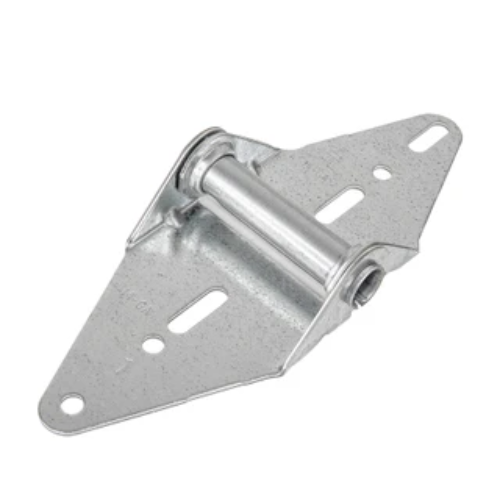
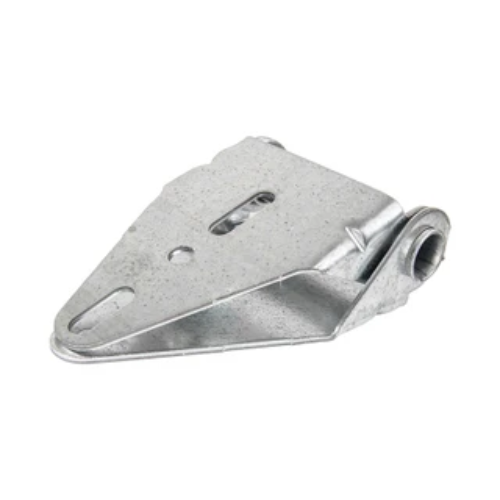
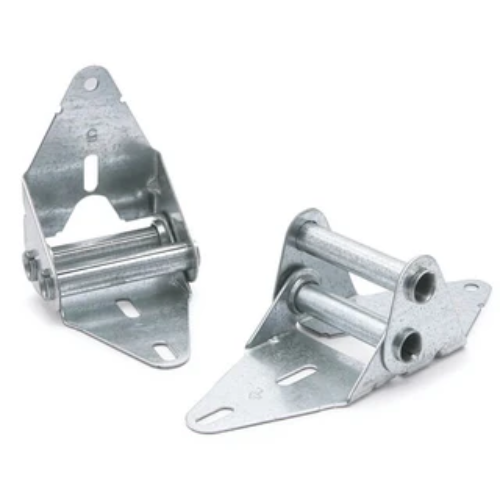
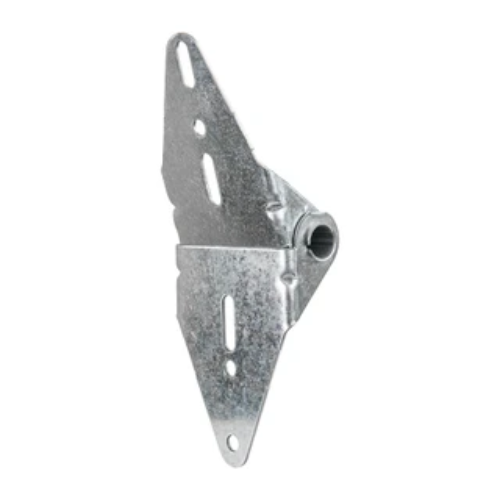
Overview
Hinges are the joints that hold a sectional garage door together. Every panel is connected to the one above and below it by hinges, and each hinge carries a roller that rides in the track as the door opens and closes. On residential garage doors, 14-gauge galvanized steel hinges provide the right balance of strength and weight for standard door panels — thick enough to hold up under daily cycling without adding unnecessary material cost for lighter residential applications.
Barron Equipment stocks Action Industries 14-gauge hinges in positions #1 through #5 for standard residential sectional garage doors. The galvanized finish protects against rust in garages exposed to moisture, humidity, and temperature swings. Each hinge accepts standard rollers with 7/16″ stems and is sold individually so you can order exactly what the job requires.
Understanding Hinge Position Numbers
Each hinge on a garage door has a number, and that number matches the section joint where it installs. The #1 hinge goes at the top section joint, #2 at the next joint down, and so on toward the bottom of the door. What changes from one position to the next is the roller offset — the distance between the hinge pivot and the roller stem. Lower-numbered hinges near the top of the door have less offset, while higher-numbered hinges farther down have more offset to keep the rollers properly aligned in the track as the door articulates through the curved radius from vertical to horizontal travel.
Installing the wrong hinge number at a given position will cause the roller to sit too close to or too far from the track, resulting in binding, dragging, uneven operation, or accelerated wear on the rollers and track.
Available Positions
HI014-01-H — #1 Hinge
Installs at the top section joint of the door. The #1 hinge has the least roller offset in the lineup because the top roller sits closest to the track at this point in the door’s travel path.
HI014-02-H — #2 Hinge
Installs at the second section joint from the top. Slightly more offset than the #1 to position the roller correctly at this panel connection.
HI014-03-H — #3 Hinge
Installs at the third section joint. The offset increases again to match the track geometry at this position — a critical transition zone on most residential doors where the track begins curving from vertical to horizontal.
HI014-04-H — #4 Hinge
Installs at the fourth section joint. Greater offset handles the wider track spacing required at this lower panel position on standard-height residential doors.
HI014-05-H — #5 Hinge
Installs at the fifth section joint on taller residential doors with five or more sections. This is the highest-offset 14-gauge hinge in the lineup and covers the lowest section joint on the tallest standard residential doors.
When to Replace Residential Hinges
Garage door hinges don’t get replaced as often as springs or rollers, but they do wear out — and when they fail, the symptoms can mimic other problems. A cracked hinge can cause a section joint to sag, the roller to tilt in the track, or the door to bind at a specific point during travel. Worn hinge barrels develop play that creates noise and uneven section gaps. If the door is noisy at the joints, sections aren’t sitting flush, or rollers keep coming out of alignment at the same spot, inspect the hinges at that position before looking elsewhere.
Hinges should also be inspected during any spring replacement, tune-up, or service call. A new spring won’t fix a door that has a cracked hinge holding a roller out of position.
Selection Assistance
Identifying the right hinge is straightforward — match the number stamped on the existing hinge to the corresponding SKU. If the stamp has worn off, count the section joints from the top of the door to find the position number. For doors with more than five sections or doors that carry heavier panels, 11-gauge hinges (available separately) provide the additional strength those applications require. Contact Barron Equipment if you need help confirming the right hinge for your door.