
Overview
A garage door T-handle lock works by turning a handle on the outside of the door, which pulls a chain on the inside, which slides lock bars into the vertical track on each side of the door. That chain — the mechanical link between the T-handle and the lock bars — is a sash chain. It’s a flat-link chain with a smooth, flexible profile that runs through guides and around pulleys inside the door panel, converting the rotational motion of the T-handle into the linear motion that extends and retracts the lock bars.
Sash chain wears, stretches, and eventually breaks. When it does, the T-handle turns freely but the lock bars don’t move — the door can’t be locked from the outside. The chain is also the first thing to fail if the door is operated by an electric operator while the lock bars are engaged, because the sudden upward force on the locked door yanks the chain against the full weight of the door and the power of the operator motor.
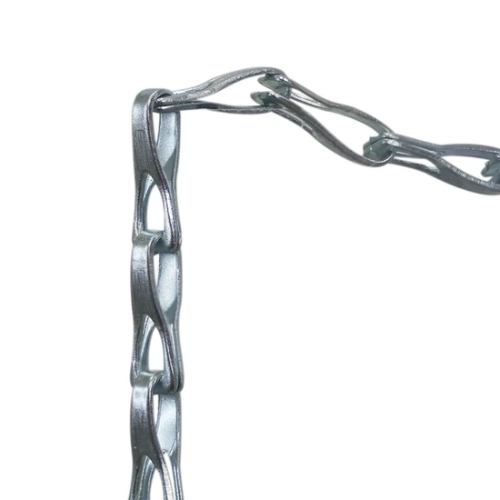
Barron Equipment stocks this Action Industries #8 sash chain in bulk, sold per foot. Order the exact length the job requires — no pre-cut packages to work around.
Product Details
10008-00-Z — Sash Chain, #8, Per Foot
Standard #8 sash chain for garage door lock kits and manual T-handle locking systems. The flat-link design runs smoothly through the chain guides and pulleys mounted inside the door panel. Sold by the foot to allow precise length ordering for any door width and lock bar configuration.
- Size: #8
- Sold by: The foot (bulk)
- Type: Flat-link sash chain
- Application: T-handle lock kits and manual locking systems on garage doors
How Sash Chain Works in a Lock Kit
A complete garage door T-handle lock system consists of the exterior T-handle, two lock bars (one per side), chain guides or pulleys, and the sash chain that ties it all together. Here’s the sequence:
The T-handle passes through the door panel from the outside. On the interior side, the handle connects to a chain sprocket or pulley. The sash chain wraps around this pulley and runs in both directions — left and right — through guides mounted on the inside of the door panel. Each end of the chain connects to a lock bar. When the T-handle is turned, the pulley takes up chain on one side and releases it on the other, sliding both lock bars simultaneously — one into the left track and one into the right track. Turning the handle the opposite direction reverses the motion and retracts both bars.
The sash chain is under tension every time the handle is turned and every time the door vibrates during normal operation. Over thousands of lock and unlock cycles, plus the constant low-level vibration from the door opening and closing, the chain links stretch and the connection points wear. When a link fails, the chain breaks and the entire lock system stops functioning.
When to Replace Sash Chain
The most common signs that the sash chain needs replacement:
T-handle turns but the bars don’t move: The chain has broken or disconnected from the lock bar. The handle rotates freely because there’s no chain resistance pulling the bars into the track.
Only one bar extends: The chain has broken on one side. One lock bar still functions because the chain is intact on that half, but the other side is disconnected.
Handle is stiff or inconsistent: Stretched links, kinked chain, or debris in the chain guides can cause the handle to bind or feel uneven during rotation. If cleaning the guides doesn’t resolve it, the chain is likely stretched beyond its working tolerance.
Visible damage: If the chain is accessible through the lock access hole in the door panel, inspect it for broken links, excessive stretch (links no longer lay flat against each other), corrosion, or kinks. Any visible damage warrants replacement.
How Much Chain Does a Door Need
The total length depends on the door width and the lock bar configuration. The chain runs from one lock bar, across the door through guides, around the T-handle pulley at center, and out to the opposite lock bar. For a standard 16-foot two-car garage door, the chain run is typically 14 to 18 feet total. For a single-car 8- to 9-foot door, 7 to 10 feet is common. Measure the existing chain if replacing, or measure the internal chain path from lock bar to lock bar through the guides and around the T-handle pulley. Order a few extra feet for connection allowance at each lock bar.
Selection Assistance
Confirm the chain size on the existing lock system before ordering. This is #8 sash chain — the standard size for most residential garage door lock kits. If the lock kit uses a different chain size, the replacement must match. The chain size is sometimes stamped on the existing chain links or listed in the lock kit manufacturer’s specifications. Contact Barron Equipment for help sizing sash chain for your lock system.