
Overview
Action Industries steel face dock bumpers combine the impact-absorbing construction of laminated recycled rubber with a steel wear plate on the face of the bumper. The steel surface is specifically designed to handle the vertical friction created by air-ride suspension trailers, yard jockeys, and spotter trucks — conditions that rapidly wear through standard rubber dock bumpers and lead to premature replacement.
When an air-ride trailer is loaded or unloaded, the suspension allows the trailer bed to rise and fall as forklifts move cargo on and off. This vertical movement creates sliding friction against the dock bumper face. On a conventional rubber bumper, this friction grinds through the rubber surface in a fraction of the time it would take normal trailer backing impacts to cause the same damage. The steel face eliminates this problem by providing a hardened wear surface that resists vertical abrasion while the rubber core underneath continues to absorb horizontal impact energy.
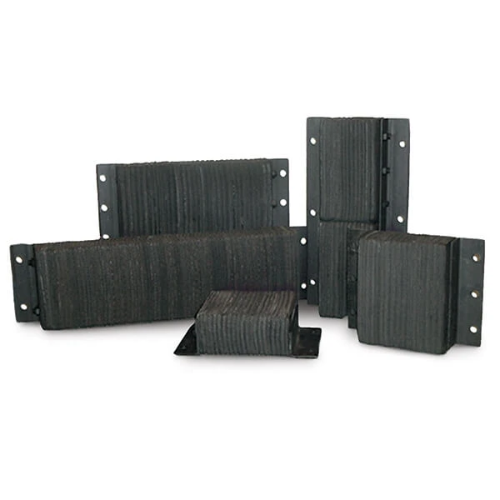
Barron Equipment carries the full Action Industries steel face dock bumper lineup, with 18 SKUs covering heights from 10 inches to 24 inches, widths from 10 to 24 inches, and projections from 4 inches to 8 inches.
Construction
The core of every steel face dock bumper is the same laminated rubber structure used in Action Industries’ standard dock bumpers — layers of fabric-reinforced recycled truck and bus tire pads compressed together and secured with steel rods. This core provides the impact absorption that protects the dock face, building structure, and dock equipment from trailer contact forces.
What distinguishes the steel face models is the steel plate mounted to the bumper’s contact surface. This plate takes the brunt of the vertical friction generated by air-ride trailers, preventing the rubber underneath from wearing through. The result is a bumper that handles both the horizontal impact of trailer backing and the vertical abrasion of fluctuating trailer heights — two distinct forces that standard rubber bumpers are not designed to manage simultaneously.
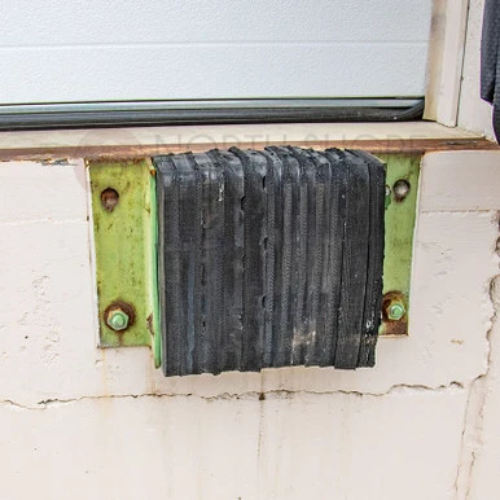
Pre-drilled steel mounting plates on the back of the bumper provide secure attachment to the dock face. Models are available in one-plate and two-plate configurations to accommodate different structural requirements and mounting conditions.
Available Sizes
Action Industries steel face dock bumpers are available in the following height, width, and projection combinations:
- 10″ Height — 14″ width, 4″ projection. Standard height for conventional semi-trailer docks receiving air-ride trailers.
- 12″ Height — 14″ and 24″ widths, with 4″ and 6″ projections. Increased vertical coverage for docks with moderate trailer height variation.
- 20″ Height — 11″ width, with projections ranging from 4″ to 8″ (including 5″ and 6.75″ options). Tall-profile bumpers for facilities receiving a wide mix of trailer heights or operating on declined approaches.
- 24″ Height — 10″ and 11″ widths, with projections from 4″ to 8″. Maximum vertical coverage for challenging dock geometries and mixed-fleet facilities.
Select models include one-plate or two-plate mounting configurations. With 18 SKUs across the lineup, there is a steel face option for most dock applications where air-ride trailer traffic or vertical friction is a concern.
When to Use Steel Face Instead of Standard Rubber
Standard laminated rubber dock bumpers are the right choice for conventional semi-trailer docks where trailers back in, make contact, and remain stationary during loading. The rubber surface absorbs the impact and holds up well over thousands of cycles.
Steel face bumpers are the right choice when any of these conditions are present at your dock:
Air-ride suspension trailers — The trailer bed rises and falls as forklifts load and unload, creating vertical friction against the bumper face that wears through standard rubber quickly.
Yard jockeys and spotter trucks — These vehicles frequently reposition trailers at the dock, creating repeated lateral and vertical movement against the bumper surface.
High-cycle docks — Facilities receiving dozens of trailers per day put cumulative wear on bumper faces. The steel surface extends bumper life significantly compared to rubber-only models in these environments.
Mixed fleets — Docks that receive both standard spring-suspension and air-ride trailers benefit from the steel face because it accommodates both contact types without accelerated wear.
Selection Assistance
Start with the same three measurements used for any dock bumper: the height of the contact zone on your dock face, the width of the area to be protected, and the required projection between the dock face and the trailer when backed in.
If your facility primarily receives air-ride trailers, uses yard jockeys, or operates high-cycle docks, the steel face configuration is the recommended starting point. For docks that only receive conventional spring-suspension trailers with minimal repositioning, the standard Action Industries laminated dock bumper may be sufficient and more cost-effective.
Plate configuration should match the structural demands of your dock. Two-plate bumpers provide additional mounting strength and are recommended for heavy-traffic facilities. Single-plate models are suitable for lighter-duty applications or replacement installations matching existing hardware.
Need help determining whether your dock requires steel face or standard bumpers? Contact the Barron Equipment team. Our loading dock specialists can assess your trailer traffic patterns, dock geometry, and operating conditions to recommend the right bumper configuration.