
Overview
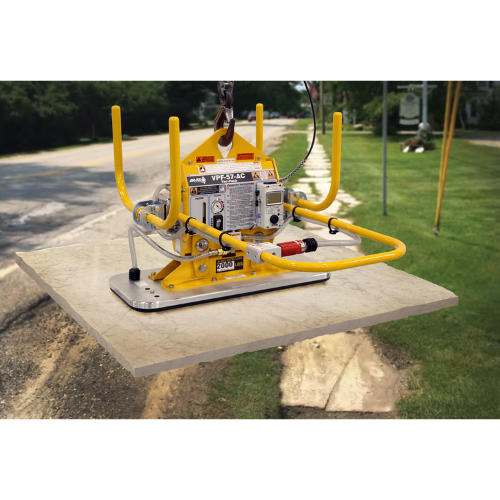
Barron Equipment carries the full ANVER stone industry vacuum lifter line — purpose-built vacuum lifting systems designed specifically for handling granite slabs, marble, engineered stone, and concrete. Unlike general-purpose vacuum lifters that use standard rubber suction pads, ANVER’s stone lifters feature specialized vacuum pads with replaceable foam seals and a unique filter-reservoir system built to perform reliably in environments with constant moisture and stone dust.
Whether your fabrication shop needs to pull slabs off near-vertical A-frame racks, position countertop blanks on cutting tables, or tilt finished pieces for installation, ANVER offers a stone vacuum lifter configured for the task. Single pad and multi-pad models handle loads from 500 lbs. to 2,000 lbs. with the option of gravity tilt or powered tilt for 90-degree repositioning.
Handling Smooth and Rough Stone Surfaces
One of the biggest challenges in stone fabrication is that surface textures vary dramatically — from mirror-polished granite to rough sawcut and flamed finishes. A vacuum lifter designed for polished surfaces will not maintain a reliable seal on rough stone, and vice versa. ANVER solves this by offering models specifically rated for smooth polished surfaces, as well as models rated for the full range from smooth polished to rough sawcut and flamed stone. This means one lifter can handle most of your stone types and surface textures without swapping equipment between jobs.
The key to this versatility is ANVER’s replaceable foam seals on the vacuum pads. When seals wear from contact with abrasive stone surfaces, they can be replaced in the field without removing the pad from the lifter — keeping downtime to a minimum in a production environment where slabs move daily.
Gravity Tilt vs. Powered Tilt
ANVER offers two tilt systems for stone handling, each designed for a different workflow. Gravity tilters allow 90-degree tilting with 6 tilt lock pin positions, using the weight of the stone to control the tilt angle. The operator positions the slab near-vertically on a rack, then uses the gravity tilter to bring it to horizontal on a fabrication table — or reverse the process. Gravity tilters are economical and have no powered tilt components to maintain.
Powered tilters use an actuator or cylinder to tilt the stone in the air without the edges touching the ground. This is the preferred option for production work where speed and added safety are priorities. Powered tilt lets the operator stop at any intermediate angle, and the stone remains fully suspended throughout the tilt cycle. Available in both air powered and electric powered configurations.
Features and Benefits
ANVER stone vacuum lifters are engineered for the demanding conditions found in stone fabrication shops and countertop production facilities. Key features include:
- Vacuum pads with replaceable foam seals designed for smooth polished to rough sawcut and flamed stone surfaces
- Large dual filter and reservoir system specifically designed to operate in moisture and stone dust environments
- Air powered vacuum pump with no moving parts — no electric motors or switches to burn out from dust exposure
- 90-degree gravity tilt with 6 tilt lock pin positions, or powered tilt with intermediate angle control
- Articulating handlebar with 6 adjustable pin positions for operator comfort and load control
- Vacuum attach and release control valve with safety lock, mounted to the handlebar
- Single pad models from 500 to 1,000 lbs. capacity; two-pad models from 1,000 to 2,000 lbs. capacity
- Powered tilter models available with up to 8 pads for larger slab sizes
- All-welded, rugged construction designed for maximum uptime with minimum service
Applications
ANVER stone vacuum lifters serve fabrication shops, countertop manufacturers, stone distributors, and installation contractors handling granite, marble, quartz, engineered stone, and concrete products. Common applications include pulling slabs from near-vertical storage racks onto fabrication tables, repositioning cut countertop sections between CNC machines, saws, and polishing stations, tilting finished pieces from horizontal to vertical for transport and installation, loading and unloading stone slabs from shipping crates and delivery trucks, and handling large format tile and stone panels in architectural and commercial construction projects.
Selection Assistance
Choosing the right stone vacuum lifter starts with your most common slab weight, the surface textures you handle most often, and whether you need gravity tilt or powered tilt capability. ANVER offers models that cover the full range from polished-only to rough-and-polished, so one system can handle most of your daily workflow without limiting you to a single finish type.
Barron Equipment’s team can help evaluate your slab sizes, weights, surface types, and production volume to recommend the right ANVER stone lifter for your shop. For applications that also require forklift-mounted vacuum lifting, Barron carries the ANVER fork truck vacuum attachment which handles granite, stone, and other non-porous materials from a fork truck.
Contact Barron Equipment to request a quote or discuss a stone vacuum lifting solution for your fabrication shop.