
Overview
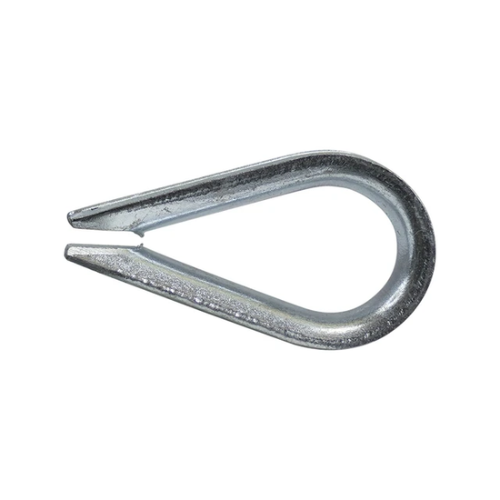
Every cable loop in a garage door assembly has a weak point — the bend. When wire rope is formed into an eye and secured with a sleeve or clamp, the inside of that loop bears the load. Without reinforcement, the cable strands at the bend get crushed, kinked, and abraded over time, weakening the connection and shortening the life of the assembly. Wire rope thimbles eliminate that problem by cradling the inside of the loop with a smooth, contoured surface that distributes the load evenly and protects the cable from deformation.
Barron Equipment stocks Action Industries cable thimbles in three sizes for commercial and industrial garage door cable assemblies. Each size is packaged in 100-piece bags for shop inventory and high-volume cable assembly work.
Available Sizes
Select the thimble that matches your wire rope diameter. The thimble needs to sit snugly inside the cable loop so it supports the bend properly. A thimble that’s too small will pinch the cable, and one that’s too large won’t support the eye under load.
5/32″ – CA163-0100
Sized for 5/32″ aircraft cable, this thimble fits the mid-range wire rope diameter used on heavier residential doors and lighter commercial overhead door systems. It provides loop protection at the connection points where the cable meets the bottom bracket, drum, or other hardware.
- Fits: 5/32″ wire rope
- Package: Bag of 100
3/16″ – CA164-0100
The 3/16″ thimble is built for commercial garage door cable assemblies. Doors with heavier panels and stronger torsion loads use thicker cable, and the loop terminations on that cable need a thimble that matches the larger diameter to maintain proper eye shape under working tension.
- Fits: 3/16″ wire rope
- Package: Bag of 100
1/4″ – CA165-0100
The largest thimble in the lineup, designed for 1/4″ wire rope found on heavy commercial and industrial garage door systems. At this cable diameter, the forces acting on the eye loop are significant — the thimble ensures the loop holds its shape and the cable doesn’t get crushed at the bend under high tension loads.
- Fits: 1/4″ wire rope
- Package: Bag of 100
Why Thimbles Matter in Cable Assemblies
A cable loop without a thimble will eventually deform under load. As the eye gets squeezed, the wire rope strands at the bend compress against each other, creating friction, heat, and accelerated wear. Over hundreds or thousands of door cycles, that wear weakens the cable at the very point where it’s under the most stress — the connection to the bottom bracket, clevis, or drum.
Installing a thimble inside the loop before crimping the sleeve or tightening the clamp prevents this. The thimble’s grooved channel holds the cable in a smooth radius, and the rigid body of the thimble absorbs the compressive force that would otherwise crush the wire rope. The result is a cable assembly that maintains full strength at the loop termination for the life of the cable.
How to Install a Wire Rope Thimble
Place the thimble inside the cable loop before the assembly is secured. The wire rope should sit in the thimble’s grooved channel, wrapping around the contoured shape with the open end of the thimble facing the cable tail. Once the thimble is positioned, secure the loop with a cable sleeve (swaged) or cable clamp (U-bolt). The thimble stays in place permanently — it doesn’t need separate fasteners or adhesive.
Thimbles, Sleeves, Stops, and Clamps — How They Work Together
In a complete garage door cable assembly, each component serves a specific role. The thimble protects the inside of the cable loop. The cable sleeve or cable clamp secures the loop closed. And the cable stop finishes the end of the wire rope to prevent fraying. On a typical torsion cable assembly, the thimble goes inside the eye at the bottom bracket or drum attachment point, the sleeve is crimped over the doubled-back cable to lock the loop, and the stop is swaged onto the tail end to keep the strands together. All four products work together to create a cable termination that holds securely under spring tension.
Selection Assistance
Need help matching a thimble to your cable assembly? Measure the wire rope diameter and select the corresponding thimble size. If you’re building assemblies for a specific door system and need guidance on which combination of thimbles, sleeves, and stops to use, contact Barron Equipment — we can help you spec the right parts.