
Overview
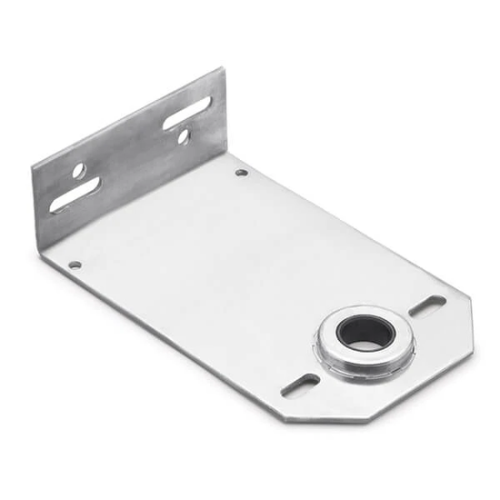
A center bearing plate mounts to the header above the garage door opening and supports the torsion spring shaft at an intermediate point between the end bearing plates. On doors where the shaft spans a wide opening — or where the spring system divides into left and right assemblies on either side of a center anchor — the center bearing plate holds the shaft straight and prevents it from sagging under the combined weight of the springs, the shaft itself, and the torsional loads of normal door operation.
Unlike a pillow block bearing, which is a standalone housing that bolts to any structural surface for commercial and industrial shafts, a center bearing support plate is a flat mounting plate designed to fasten directly to the header above the door. It’s the standard mid-span shaft support on residential and light commercial garage doors running 1″ torsion shafts.
Barron Equipment stocks Action Industries center bearing support plates in six configurations — varying in plate size, gauge, and whether the 1″ bearing is included or sold separately.
With 1″ Bearing
These plates ship with a 1″ ID bearing already installed in the plate, ready to slide onto the torsion shaft and mount to the header. For new installations and full replacements, ordering the plate with the bearing included saves a step and ensures the bearing and plate are matched.
104-0172 — 4-3/8″, 11 Gauge, with 1″ Bearing
The most compact plate in the lineup. The smaller profile and lighter 11-gauge construction make this the right fit for standard residential doors on narrower openings where space above the door is tight and the shaft loads are light.
- Plate size: 4-3/8″
- Gauge: 11
- Bearing: 1″ ID, included
- Application: Standard residential
HB338-8G-H — 5-1/2″ x 3-3/8″, 8 Gauge, with 1″ Bearing
Steps up to 8-gauge steel for a heavier, more rigid plate while maintaining the 3-3/8″ width. The added thickness resists flex under load better than the 11-gauge option, making this a good fit for heavier residential doors or any application where the thicker plate provides extra confidence in the shaft support.
- Plate size: 5-1/2″ x 3-3/8″
- Gauge: 8
- Bearing: 1″ ID, included
- Application: Heavy residential
HB438-8G-H — 5-1/2″ x 4-3/8″, 8 Gauge, with 1″ Bearing
A wider plate that spreads the mounting footprint across more header surface area. The increased width provides additional stability on heavier door systems where the shaft loads justify a larger support plate.
- Plate size: 5-1/2″ x 4-3/8″
- Gauge: 8
- Bearing: 1″ ID, included
- Application: Heavy residential to light commercial
HB500-8G-H — 5-1/2″ x 5″, 8 Gauge, with 1″ Bearing
Steps into the commercial range with a 5″ wide plate. The broader mounting surface distributes the shaft load across a wider section of the header, reducing point stress on the mounting fasteners and the header structure itself.
- Plate size: 5-1/2″ x 5″
- Gauge: 8
- Bearing: 1″ ID, included
- Application: Commercial
HB600-8G-H — 5-1/2″ x 6″, 8 Gauge, with 1″ Bearing
The widest plate in the lineup. The 6″ width provides the largest mounting footprint for maximum load distribution on the heaviest door systems running 1″ torsion shafts. This is the plate to specify when the door weight, the spring load, or the header condition requires the most robust mid-span support available.
- Plate size: 5-1/2″ x 6″
- Gauge: 8
- Bearing: 1″ ID, included
- Application: Heavy commercial
Without Bearing
104-0022 — 5-1/2″ x 3-3/8″, 8 Gauge, No Bearing
The same 8-gauge plate as the HB338-8G-H, but without the bearing installed. This is the right choice when the existing bearing is still in good condition and only the plate needs to be replaced, or when the technician prefers to source the bearing separately to match a specific specification. The bearing must be purchased and installed separately before the plate can support the shaft.
- Plate size: 5-1/2″ x 3-3/8″
- Gauge: 8
- Bearing: Not included — sold separately
- Application: Replacement plate when bearing is reused or sourced separately
Plate Width and When It Matters
The width of the support plate determines how much header surface area shares the shaft load. On a standard residential door with a lightweight insulated panel, the 3-3/8″ plate provides more than enough support. As door weight increases — heavier panels, wider openings, higher spring loads — the shaft pushes harder against the bearing, which pushes harder against the plate, which pushes harder against the header. A wider plate spreads that force across more fasteners and more header material, reducing the chance of the plate pulling away from the header or the fasteners pulling through the wood or steel.
If the existing header is softwood or shows any signs of weakening around the old mounting holes, stepping up to a wider plate distributes the load more evenly and extends the life of the connection.
8 Gauge vs. 11 Gauge
Gauge refers to the thickness of the steel plate. A lower gauge number means thicker steel. 8-gauge steel is approximately 0.164″ thick — significantly more rigid than 11-gauge at approximately 0.120″. The thicker plate resists bending under load and provides a more solid mounting platform. For standard residential doors with moderate spring loads, 11-gauge is adequate. For heavier doors, wider openings, or any application where added rigidity is a priority, 8-gauge is the better specification.
Selection Assistance
To select the right center bearing plate, determine whether you need the bearing included or separate, choose the gauge (11 for light residential, 8 for everything heavier), and select the plate width based on the door weight and header condition. When in doubt, go wider and heavier — the cost difference between plate sizes is minimal, and a sturdier plate is always better than one that’s undersized for the load. Contact Barron Equipment for help matching the right plate to your installation.