
Overview
On a commercial or industrial garage door with a chain hoist, the hand chain hangs in a continuous loop from the hoist sprocket down to the operator’s pulling height. When nobody is operating the door, that chain is just hanging there — swinging, dangling, and waiting to get caught on a forklift, a pallet, a person walking by, or the door itself during the next open-close cycle. In busy loading dock and warehouse environments, a loose chain loop is a nuisance at best and a safety hazard at worst.
A chain keeper solves this by holding the hand chain in a fixed position against the wall when the hoist isn’t being used. The chain loops through or around the keeper and stays put — neat, off the floor, out of traffic lanes, and immediately accessible when the operator needs to work the door.
Barron Equipment stocks this Action Industries chain keeper for standard garage door chain hoist systems.
Product Details
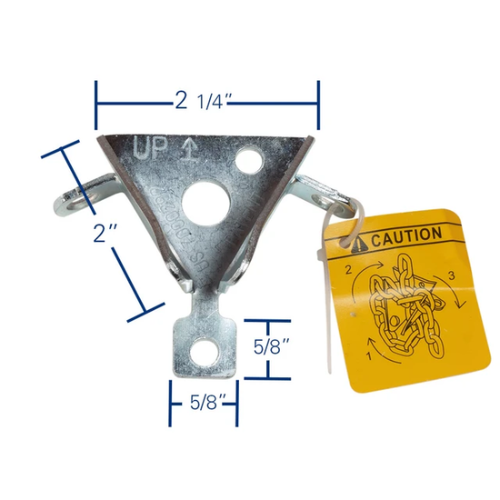
DA059-CK-H — Chain Keeper
A simple, durable bracket designed to hold the hand chain of a garage door chain hoist in a tidy, accessible position when not in use. Mounts to the wall adjacent to the hoist and keeps the chain loop organized, off the floor, and out of the way of foot traffic, forklift lanes, and door operation.
- Function: Holds hand chain in position when not in use
- Mounting: Wall-mounted, adjacent to chain hoist
- Application: Commercial and industrial garage door chain hoist systems
- Prevents: Tangling, floor contact, interference with traffic and equipment
Why Chain Keepers Matter
A chain keeper is one of those small pieces of hardware that doesn’t seem important until it’s missing. Here’s what happens without one:
Tangling: A free-hanging chain loop twists on itself over time, especially in environments with air movement from HVAC systems, open dock doors, or vehicle traffic. Once tangled, the chain can jam on the hoist sprocket the next time someone tries to operate the door — requiring the operator to stop and untangle the chain before the door will move.
Floor contact: On taller doors, the bottom of the chain loop can reach or drag on the floor. Chain on the floor picks up dirt, grit, moisture, and debris that accelerate wear on both the chain links and the hoist sprocket. Floor contact also creates a trip hazard.
Equipment interference: In loading dock and warehouse environments, forklifts, pallet jacks, and carts pass through the door opening constantly. A swinging chain loop in the path of moving equipment can get caught, pulled, or run over — damaging the chain, the hoist, or the equipment.
Safety: OSHA and workplace safety standards emphasize keeping work areas clear of loose hanging objects that can entangle workers or interfere with equipment operation. A chain keeper is a simple compliance measure that addresses this requirement.
Where to Mount the Chain Keeper
Mount the chain keeper on the wall adjacent to the chain hoist, at a height that gathers the chain loop into a neat bundle without putting excessive tension on the chain. The keeper should be positioned so the chain is easy to lift off when the operator needs to use the hoist, but secure enough that it doesn’t fall off on its own from vibration or air movement. Typical mounting height is between 4 and 6 feet above the floor — high enough to keep the chain completely off the floor and out of forklift paths, low enough for the operator to reach it easily.
Selection Assistance
This chain keeper is designed for standard garage door chain hoist hand chains. One keeper per hoist is typically sufficient. For doors with exceptionally long hand chain runs (tall commercial openings), a second keeper mounted lower on the wall can help manage the additional chain length. Contact Barron Equipment for help with chain management on your hoist installation.