
Overview
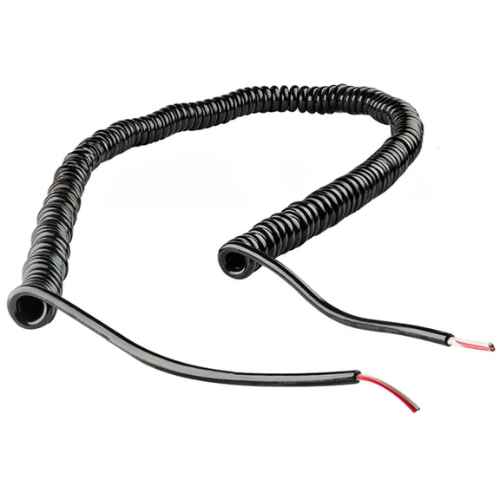
Coil cords provide the electrical connection between safety sensing edges and commercial garage door operators. As the door opens and closes, the coiled cable extends and retracts with the door’s movement — maintaining a continuous signal path between the sensing edge mounted on the door and the operator or junction box mounted on the wall or header. Without a functioning coil cord, the safety edge cannot communicate with the operator, and the reversing function will not activate when an obstruction is detected.
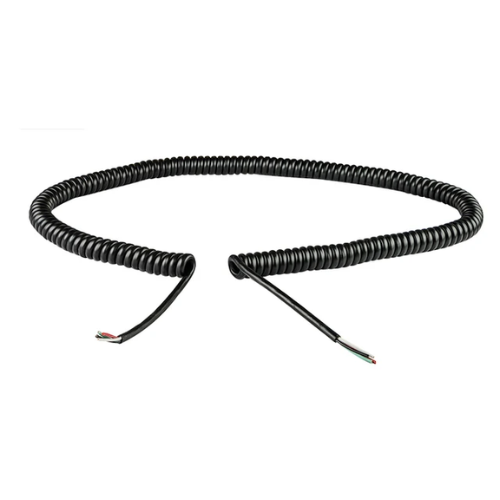
Barron Equipment carries Miller Edge coil cords in both 2-wire and 4-wire configurations, available in multiple extended lengths to accommodate different door sizes and mounting distances. Every cord in this lineup is built with 18 AWG stranded conductors and a heavy-duty polyurethane jacket designed to withstand thousands of extension and retraction cycles without losing conductivity or coiling memory.
Features and Benefits
The polyurethane outer jacket is the defining construction feature across this product line. Unlike standard PVC-jacketed cables that can stiffen, crack, or lose their coil shape over time, polyurethane maintains its flexibility and retraction memory through repeated cycling in commercial door environments. This is critical for doors that operate dozens or hundreds of times per day — the cord needs to extend fully on every cycle and retract cleanly without binding, tangling, or creating slack that could catch in the door mechanism.
The 18 AWG stranded wire conductors deliver reliable signal transmission for both non-monitored and monitored safety edge systems. Two-wire cords are designed for standard non-monitored sensing edge connections, while four-wire cords support monitored safety edge systems that require additional conductors for diagnostic or supervisory circuits.
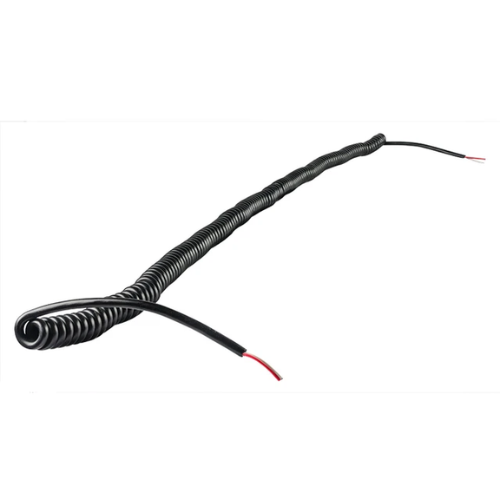
Each cord retracts to a compact length when the door is closed — typically around 2 to 4 feet depending on the model — keeping the installation clean and preventing excess cable from hanging in the door opening. When the door opens, the cord extends smoothly to its full rated length without pulling on connections or creating strain on the junction box or sensing edge terminals.
Available Models
- C2564-00-Z — 2-wire, 18 AWG, 20 ft extended length. The most common length for standard commercial overhead door installations.
- C2565-00-Z — 2-wire, 18 AWG, 12 ft extended length. Compact option for shorter door heights or closer mounting distances.
- C2566-00-Z — 2-wire, 18 AWG, 24 ft extended length. Extended reach for taller doors or installations where the junction box is mounted further from the sensing edge.
- C5253-00-Z — 22 AWG, 2-wire, 15 ft extended length. Lighter gauge option for compatible sensing edge systems.
- C2567-00-Z — 4-wire, 18 AWG, 12 ft extended length. Designed for monitored safety edge systems requiring additional conductors.
- C2568-00-Z — 4-wire, 18 AWG, 24 ft extended length. Extended reach for monitored safety edge installations on taller doors.
Applications
Coil cords are used on any commercial door system where a wired safety sensing edge is installed on the moving door panel and needs to communicate with a stationary operator, transmitter, or junction box. They are the standard wiring method for pneumatic and electric sensing edges on commercial overhead doors, rolling steel doors, sectional garage doors, and industrial access doors.
These cords are equally suited for new installations and replacement jobs. On existing door systems, a coil cord is often the first component to fail — repeated cycling eventually fatigues the conductors or degrades the jacket, leading to intermittent signal loss or complete safety edge failure. Replacing the cord restores full sensing edge functionality without replacing the edge itself or the air switch.
Common installation environments include commercial warehouses, loading docks, distribution centers, fleet maintenance facilities, fire stations, and any commercial property where overhead doors operate with motorized operators and safety sensing edges.
Selection Assistance
Start by confirming the wire count your safety edge system requires. Non-monitored sensing edges — including pneumatic reversing edges that use an air switch — typically require a 2-wire cord. Monitored sensing edges that include supervisory or diagnostic circuits require a 4-wire cord. Check your sensing edge documentation or operator manual to verify the correct configuration.
Next, determine the extended length you need. Measure the distance from the sensing edge connection point on the door to the junction box or operator terminal where the cord will connect. Add a few extra feet to allow for routing and strain relief. The 20-foot model is the most common choice for standard commercial overhead doors, but taller doors or installations with longer routing distances may require the 24-foot option.
If you are replacing an existing coil cord, match the wire count and gauge of the original cord. Switching from a 2-wire to a 4-wire cord (or vice versa) without confirming system compatibility can result in incorrect wiring or safety edge malfunction.
Not sure which coil cord fits your door system? Contact the Barron Equipment team. Our commercial door specialists can help you identify the correct model based on your sensing edge, operator, and door configuration.