
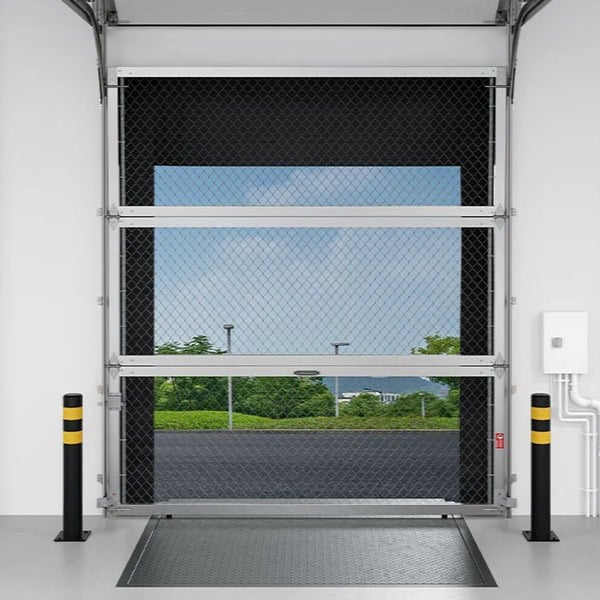
Secure Openings Without Blocking Airflow
Open loading dock and warehouse doors can improve airflow but may also expose a facility to unauthorized access, birds, insects, and other pests. A commercial overhead screen door helps maintain a physical barrier while allowing air and natural light through the opening.
Potential benefits include:
- Natural ventilation and daylight
- Visibility through the opening
- Bird and insect exclusion
- Perimeter access control
- Compatibility with existing overhead doors
- Multiple mesh and track configurations
The appropriate system depends on the opening, existing door, desired ventilation, pest-exclusion needs, security requirements, and available clearance.
Mesh and Screen Options
| Screen Option | Primary Use | Key Consideration |
|---|---|---|
| 12-Mesh Wire Cloth | General security and bird exclusion | Supports greater visibility and open area |
| 16-Mesh Wire Cloth | Insect exclusion and ventilation | Balances pest control with airflow |
| 30-Mesh Wire Cloth | Fine-insect exclusion | Finer mesh may reduce ventilation |
| 9-Gauge Chain Link | Heavy-duty perimeter security | Not designed for fine-insect exclusion |
Track and Installation Configurations
Commercial screen doors can be configured around an existing overhead door or installed as standalone systems.
Dual-Track Systems
A dual-track configuration allows the mesh screen and solid overhead door to operate independently at the same opening. During operating hours, the screen can remain closed for ventilation and access control. The solid door can then be closed for additional weather protection or after-hours security.
Behind-Rolling Systems
A behind-rolling screen is positioned behind an existing rolling steel door. This configuration may allow a facility to retain its primary door while adding a mesh barrier for daytime use.
Lift Options
Available arrangements identified in the analysis include:
- Standard lift
- High lift
- Vertical lift
- Behind rolling
- Standalone high lift
The appropriate configuration depends on the existing door, headroom, side clearance, track location, operator placement, and nearby building systems.
Loading Dock and Warehouse Applications
Commercial security screen doors may support:
- Shipping and receiving areas
- Warehouse loading bays
- Manufacturing entrances
- Distribution facilities
- Food and packaging plants
- Buildings requiring daytime ventilation
These systems help facilities keep dock or warehouse openings ventilated without leaving the bay completely unprotected.
Pest Exclusion for Food Facilities
Birds and insects can enter through open loading dock and warehouse doors. A properly selected overhead screen may support the facility’s broader pest-exclusion strategy while preserving ventilation and daylight.
Food and packaging facilities should evaluate:
- Target pest size
- Mesh density and material
- Cleaning procedures
- Corrosion exposure
- Ventilation needs
- Facility food-safety plans
- Inspection requirements
A screen door should not be described as automatically satisfying USDA, FDA, FSMA, HACCP, or AIB requirements. Suitability depends on the selected system, installation, facility procedures, and applicable regulations.
Loading Dock Safety Considerations
A closed screen door creates a physical barrier across an open dock bay, but fall-protection suitability must be evaluated for the specific facility and product configuration.
Review:
- Dock height and edge exposure
- Employee activity near the opening
- Forklift and vehicle traffic
- Screen strength and construction
- Track and bottom-panel design
- Facility operating procedures
- Applicable safety requirements
Do not assume every commercial screen door satisfies OSHA loading dock fall-protection requirements without supporting documentation for the selected system.
How to Choose a Commercial Screen Door
Consider the following before selecting a system:
- Primary goal: Security, pest exclusion, ventilation, daylight, visibility, or a combination
- Existing door: Sectional, rolling steel, or no primary door
- Mesh type: Selected according to pest size, airflow, visibility, and security
- Opening dimensions: Width, height, headroom, and side clearance
- Track geometry: Standard, high, vertical, dual-track, or behind rolling
- Facility conditions: Corrosion, cleaning, weather, food-safety, and security requirements
- Daily operation: When the solid door and screen will be opened or closed
Final measurements and existing door conditions should be evaluated before the system is ordered.
Commercial Security Screen Door Selection and Installation
Barron Equipment helps warehouses, loading docks, manufacturing facilities, and food or packaging plants compare commercial screen doors based on the existing door, opening dimensions, mesh requirements, ventilation, pest exclusion, security, and available clearance. Request a quote online to identify an appropriate overhead screen-door configuration.