
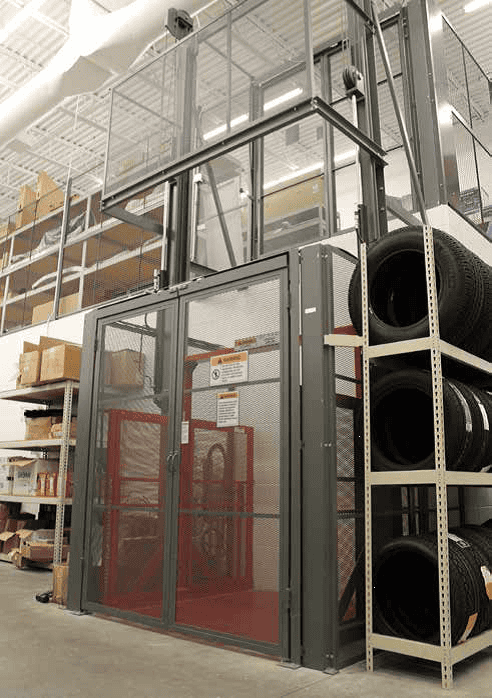
Overview
Single-level material transfer — ground floor to mezzanine, warehouse floor to balcony, or shop floor to upper storage — is the most common VRC application. Wildeck custom hydraulic lifts are designed specifically for this tier of use: moderate loads, single-stop travel, and reliable day-in, day-out operation without the cost and complexity of a mechanical chain-drive system.
Two configurations are available — straddle and cantilever — each with distinct advantages depending on the loading direction, available space, and overhead clearance. Both share the same core hydraulic system, safety features, and modular bolt-together construction.
Straddle Hydraulic Lift
The straddle configuration places structural columns on both sides of the carriage platform. This provides a structurally stable lift with reduced bracing requirements and lower wheel loads for extended service life. The straddle design supports C or Z loading and unloading patterns, giving flexibility in how material enters and exits the lift at each level.
- Platform sizes up to 8 ft wide x 12 ft long
- C or Z loading and unloading patterns
- Structurally stable design reduces component wear
- Lower wheel loads for extended roller and guide life
Cantilever Hydraulic Lift
The cantilever configuration places structural columns on one side only, leaving the opposite side open. This creates a smaller equipment footprint, lower overall height, and access from C, Z, or 90-degree loading patterns. Cantilever lifts are well suited for restricted headroom, tight spaces, and applications where material needs to be loaded from the side. Freestanding models with optional support structures are available.
- Platform sizes up to 8 ft wide x 6 ft long
- C, Z, or 90-degree loading and unloading patterns
- Smaller footprint and lower overall equipment height
- Freestanding models available with optional support structure
- Works where headroom is restricted
Standard Safety and Control Features
Every Wildeck hydraulic VRC ships with a comprehensive set of safety and control features — not as options, but as standard equipment.
- Patented AutoSenz® M-Series overload and jam protection (U.S. Patent No. 7,408,317)
- UL-508A labeled control panel with 24-volt safety control wiring
- Gate-closed indicator light on control panel
- Momentary-contact up and down push-button controls
- Pre-wired control panel and hydraulic pump unit ship as one assembly
- Dual hydraulic rams and lifting cables provide redundant safety
- Hydraulic rams pull (not push) for added strength and longer service life
- Hydraulic operating pressure maintained below 1,600 psi for extended component life
- Oversized oil reservoir reduces the risk of overheating
- Automatic shut-off valves for broken hydraulic hoses
- Manual lowering valve for emergency use
- High-flex IWRC lifting cable for extended service life
- Broken cable free-fall safety cams rated for 7,000 lbs
- Fabricated by AWS D1.1 certified welders
- Bolt-together installation — no field welding required
Applications
Wildeck hydraulic VRCs serve distribution centers with mezzanines, manufacturing facilities with upper-level storage, archive and records storage with balconies, retail back-of-house operations, self-storage facilities, and any operation that needs to move material between a ground floor and a single upper level at moderate cycle rates. The modular bolt-together design and competitive pricing make hydraulic VRCs the most accessible entry point for vertical material transfer.
Hydraulic vs. Mechanical VRC
Hydraulic VRCs are best suited for single-level (ground plus one) transfer at moderate cycle rates with loads up to 4,000 lbs and lift heights to 18 feet 6 inches. Mechanical VRCs handle heavier loads (up to 30,000 lbs with the 4XLift), reach greater heights (up to 150 ft), serve multiple levels, and support automation and higher cycle rates. Hydraulic VRCs have a lower initial cost but require more routine maintenance than mechanical systems. Choose hydraulic when the application is single-level, loads are moderate, and cost is a primary factor. Choose mechanical when loads are heavy, travel is high, or multiple stops are needed.