
Overview
Washers are one of those parts that never get attention until they’re missing from the truck. Every bolted connection on a garage door — hinges, track brackets, bearing plates, operator mounts, bottom brackets — either needs a flat washer to distribute load, a lock washer to resist vibration loosening, or both. Run out mid-job and the choice is either drive to the hardware store or leave fasteners undertorqued. Neither is acceptable.
Barron Equipment stocks Action Industries washers and keps nuts in the three bolt sizes that cover the vast majority of garage door hardware: 1/4″, 5/16″, and 3/8″. Three washer types are available — flat washers for load distribution, split lock washers for vibration resistance, and keps nuts with integrated external tooth lock washers that combine the nut and lock washer into a single fastener. All are sold in bulk packs sized for shop inventory and multi-door installations.
Flat Washers
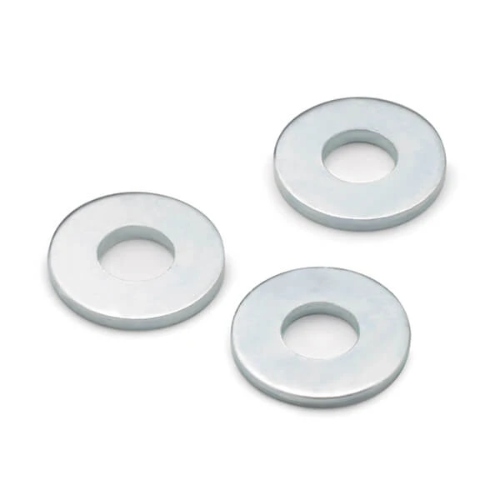
Flat washers sit between the nut (or bolt head) and the mounting surface. They distribute the clamping force of the fastener across a wider area, preventing the nut from digging into the surface and reducing the chance of the connection pulling through thin-gauge steel or soft materials. On garage door hardware, flat washers go under the nut on hinge bolts, track bracket bolts, and any connection where the bolt hole is larger than the nut face or where the mounting surface needs protection from fastener damage.
Bulk Packs
Bulk flat washers in the three standard garage door bolt sizes. Available in 500- and 1000-count packs for shop inventory, service trucks, and multi-door installations.
- FA404-10-0-0 — 1/4″ flat washer, 1000/pk
- FA405-05-0-0 — 5/16″ flat washer, 500/pk
- FA405-10-0-0 — 5/16″ flat washer, 1000/pk
- FA406-05-0-0 — 3/8″ flat washer, 500/pk
- FA406-10-0-0 — 3/8″ flat washer, 1000/pk
Individual & Specialty
Standard USS flat washers sold individually for smaller jobs, plus a stainless steel option for corrosive environments.
- 103-0028 — 5/16″ USS flat washer, individual
- 103-0027 — 3/8″ USS flat washer, individual
- 10017-00-W — #8 flat washer, SAE, stainless steel, 24/pk
The stainless steel #8 flat washer is designed for garage door hardware installations in car wash bays, loading docks with washdown areas, coastal environments, and any application where standard zinc-plated washers would corrode.
Split Lock Washers
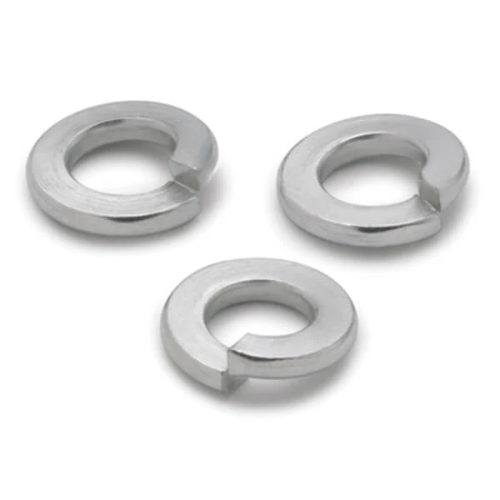
Split lock washers are spring-loaded — the washer is cut and bent so it exerts continuous outward pressure against the nut and the mounting surface. That spring tension keeps the nut from backing off under the vibration a garage door produces during every open-close cycle. Split lock washers go under the nut on any connection subject to vibration: track brackets, hinge bolts, operator mounting hardware, and spring anchor bolts.
- FA444-10-0-0 — 1/4″ split lock washer, 1000/pk
- FA445-05-0-0 — 5/16″ split lock washer, 500/pk
- FA446-10-0-0 — 3/8″ split lock washer, 1000/pk
Keps Nuts with External Tooth Lock Washer
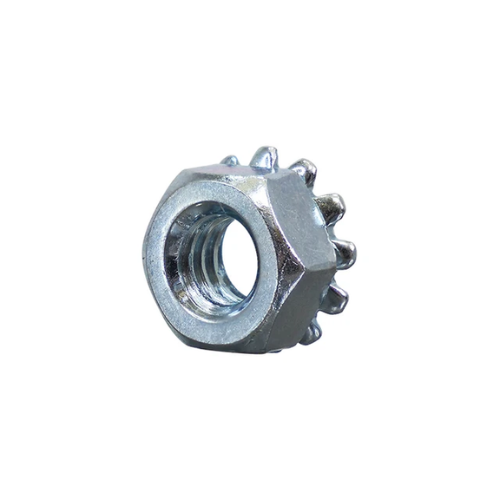
A keps nut combines a hex nut and an external tooth lock washer into one piece. The toothed washer is permanently attached to the base of the nut, so when the nut is tightened, the teeth bite into the mounting surface and create a mechanical lock that resists vibration loosening — without needing a separate lock washer. Keps nuts save time on the job because the installer handles one part instead of two and doesn’t have to fumble with a loose washer on every fastener.
Available in the same three thread sizes as the hex nuts and lock washers, in 500- and 1000-count bulk packs.
- FA304-05-0-0 — 1/4-20 keps nut, external tooth lock, 500/pk
- FA304-10-0-0 — 1/4-20 keps nut, external tooth lock, 1000/pk
- FA305-10-0-0 — 5/16-18 keps nut, external tooth lock, 1000/pk
- FA306-10-0-0 — 3/8-16 keps nut, external tooth lock, 1000/pk
Flat Washer vs. Split Lock vs. Keps Nut
Each type serves a different purpose, and many connections use more than one.
A flat washer distributes load. It doesn’t resist vibration loosening on its own, but it protects the mounting surface and gives the nut a stable seat. Use a flat washer on any connection where the bolt hole is oversized, the material is thin, or the nut face would otherwise bear directly on a painted or galvanized surface.
A split lock washer resists vibration. Its spring tension keeps constant pressure on the nut, preventing it from backing off during the thousands of vibration cycles a garage door produces over its lifetime. Use a split lock washer under the nut on any connection that vibrates — which is most of them on a garage door.
A keps nut combines the nut and the lock washer into one part. The external tooth washer bites into the surface when tightened, creating both the clamping force and the vibration lock in a single step. Use a keps nut when you want the speed of a one-piece fastener with built-in vibration resistance. Many installers have shifted to keps nuts as their default garage door nut for the time savings alone.
Selection Assistance
Match the washer or keps nut to the bolt size on the hardware you’re installing: 1/4″ washers for 1/4-20 bolts, 5/16″ for 5/16-18, and 3/8″ for 3/8-16. If you’re stocking a service truck or shop, the 1000-count packs provide the best per-unit value. For smaller jobs, the 500-count packs and individual washers keep inventory manageable. Contact Barron Equipment if you need help selecting the right fastener hardware for your application.