
Overview
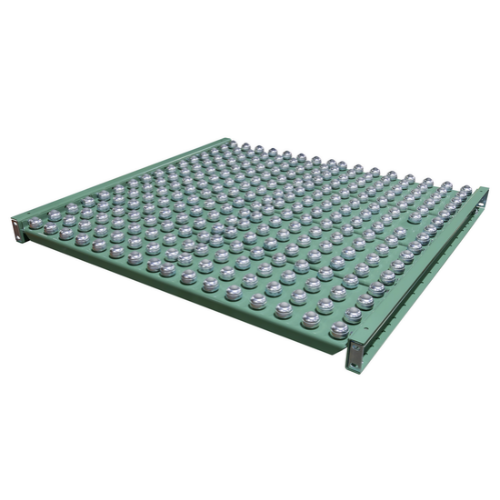
Model B uses groups of ball transfer assemblies within a conveyor frame to permit multidirectional movement of flat surfaced items. This design supports operator-centric tasks such as alignment, rotation, and positioning at workstations or packaging points. Ball transfers provide manual flexibility without power.
Unlike roller conveyors that move products in a single direction along the conveyor path, a ball transfer conveyor allows operators to push, rotate, and reposition items in any direction on the conveyor surface. This makes the Model B the right choice at points in a conveyor system where products need to be turned, aligned to a specific orientation, transferred laterally, or positioned for scanning, labeling, or packaging.
Specifications
- Ball assemblies: 1-inch diameter steel ball x 1-13/16-inch overall housing diameter. Mounting bolt is 1/4-inch-20.
- Ball capacity: 50 lbs per ball. Maximum unit load not to exceed the capacity of 4 balls (200 lbs).
- Frame: 3-1/2 in. x 1-1/2 in. x 10 ga. steel with balls in set high position (1/4 in. above side frames) only.
- Plates: Balls are attached in a square pattern to 10 ga. formed plates up to 39 in. BF. Above 39 in., plates are 7 ga.
- Couplings: Butt type.
Load Capacity
Each 1-inch steel ball supports 50 pounds. The maximum unit load is 200 pounds — the capacity of four balls in contact with the product at any time. Frame-level capacity is separate from per-unit load capacity.
- Supports on 10-foot centers: 1,300 lbs maximum distributed live load per 10-foot section
- Supports on 5-foot centers: 3,200 lbs maximum distributed live load
The 200 lb per-unit limit means individual items on the ball transfer surface must not exceed 200 pounds. Multiple lighter items can be on the surface simultaneously as long as the total distributed load does not exceed the frame capacity.
How Ball Transfer Differs from Roller Conveyors
A roller conveyor moves products in one direction — along the roller axis from infeed to outfeed. A ball transfer conveyor replaces the rollers with an array of steel balls, each of which rotates freely in every direction. This gives operators the ability to slide products forward, backward, sideways, or diagonally with minimal effort. The product can also be rotated in place.
Ball transfer sections are typically used at specific points within a larger conveyor system rather than for long-distance transport. They serve as transition zones where products need manual intervention before continuing down the line.
Applications
The Model B ball transfer conveyor is commonly used at workstation positioning points where operators align products for scanning, labeling, or inspection, packaging stations where items are rotated or repositioned before wrapping or boxing, sorting and diverting points where products are manually pushed onto branch conveyor lines, transfer points between perpendicular conveyor runs where product direction changes by 90 degrees, and end-of-line staging areas where items are arranged for palletizing or order consolidation.
Selection Assistance
Ball transfer conveyors work best for flat-bottomed products under 200 pounds that need to be repositioned by hand. Items with uneven or soft bottoms may not track well on ball transfers. For single-direction gravity flow of cartons and packages, roller conveyors in the 1.9-inch or 2.5-inch series are more appropriate.
Barron Equipment provides conveyor system planning, installation, and service support across Iowa, Illinois, and parts of Wisconsin, Minnesota, Missouri, and Nebraska. Request a quote to determine where ball transfer sections fit into your conveyor layout.