
Overview
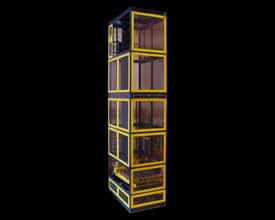
A reciprocating vertical conveyor — also called a VRC or material lift — moves products vertically between two or more levels in a facility. Unlike elevators, which are designed to carry people, VRCs are classified as conveyors under ASME B20.1 and are engineered specifically for material handling. They transport cases, totes, cartons, tires, pallets, and heavy containers between ground floors, mezzanines, upper production levels, and overhead conveyor systems without requiring a forklift, stairway, or personnel elevator.
Barron Equipment carries a full range of VRC configurations including hydraulic and mechanical drive systems in cantilever, straddle, and 4-post frame designs. Available solutions range from light-duty lifts for carton and tote handling to heavy-capacity freight lifts for pallets and industrial loads. Custom hydraulic lifts are also available for applications that require non-standard platform sizes, lift heights, or integration with automated conveyor systems.
Types of VRC Configurations
VRCs are categorized by frame configuration and drive type. The frame determines how the carriage is supported and how products are loaded and unloaded. The drive type determines the lifting method, speed, capacity, and maintenance profile.
Cantilever VRC
A cantilever VRC supports the lifting carriage from one side, leaving the other three sides open for loading and unloading. This configuration provides maximum access to the platform from multiple directions, which is important in facility layouts where loads must be loaded from the front and unloaded from the side, or where the VRC must integrate with conveyor lines approaching from different angles. Barron carries both hydraulic and mechanical cantilever VRCs for different capacity and speed requirements.
Straddle VRC
A straddle VRC uses two vertical columns — one on each side of the platform — to support the carriage. This dual-column design provides greater stability and higher load capacity than a cantilever, making it suitable for heavier loads and larger platform sizes. Loading and unloading occur from the front and rear of the platform. Straddle VRCs are commonly used for pallet and heavy container transport between floors.
4-Post VRC
A 4-post VRC uses four vertical columns at the corners of the platform for maximum structural rigidity and load capacity. This is the heaviest-duty frame configuration and is used for the largest platform sizes and highest weight capacities. The Autoquip Mechanical 4 Post VRC is a high-capacity freight lift designed for multi-level pallet and heavy unit load transfer.
Hydraulic vs. Mechanical Drive
Hydraulic VRCs use a hydraulic cylinder and power unit to raise and lower the carriage. Hydraulic systems provide smooth, controlled lifting with precise positioning and are well suited for low to moderate lift heights and heavy loads. They require a hydraulic power unit and fluid maintenance but offer reliable, consistent operation in industrial environments.
Mechanical VRCs use an electric motor, gearbox, and chain or cable system to lift the carriage. Mechanical systems support higher lift heights and faster cycle times than most hydraulic units, making them the preferred choice for taller buildings, high-throughput applications, and multi-stop configurations with three or more levels. The Autoquip Mechanical 4 Post VRC and the mechanical cantilever models in Barron’s lineup use this drive method.
Applications
VRCs serve any facility that needs to move material between levels without a forklift or manual carrying. Common applications include mezzanine transfer — moving cartons, totes, or pallets between a ground-floor production area and an elevated mezzanine used for storage, packing, or shipping. Multi-floor manufacturing operations use VRCs to transport raw materials, subassemblies, and finished products between production levels. Distribution centers and fulfillment operations use VRCs to feed overhead conveyor systems or connect floor-level operations with elevated sorting and shipping areas.
Additional applications include tire handling and storage, automotive parts distribution between warehouse levels, food and beverage operations where product must move between processing and packaging floors, and integration with automated conveyor systems where horizontal conveyors feed directly into and out of the VRC carriage for hands-free multi-level transport.
Available VRC Products
Barron Equipment carries multiple VRC models to cover light-duty through heavy-capacity applications. Available products include the 4XLift Heavy Duty Material Lift, the Delta VRC Material Lift, the FlexLoader Material Conveyor System, hydraulic cantilever and straddle VRCs, hydraulic vertical lifts in the 21 Series and D Series, mechanical cantilever VRCs, the Autoquip FreightLite Hydraulic Freight Lift for light-duty mezzanine transfer, the Autoquip Mechanical 4 Post VRC for high-capacity multi-level freight, and custom hydraulic lifts for non-standard applications. Contact Barron Equipment for help selecting the right model for your facility.
VRC vs. Freight Elevator
VRCs and freight elevators both move material between levels, but they serve different regulatory and operational categories. A VRC is classified as a conveyor under ASME B20.1 and is not designed or permitted to carry personnel. This classification typically means simpler permitting, lower installation costs, and fewer ongoing inspection requirements compared to a freight elevator, which falls under elevator codes and ADA accessibility requirements. For facilities that need to move material — not people — between levels, a VRC is often the more cost-effective and faster-to-install solution.
Selection Assistance
Start by identifying the product type, weight, and dimensions that the VRC must handle. Determine the number of levels, the lift height between each level, and the required cycle time. Consider the facility layout — specifically whether loads need to be accessed from one side (cantilever), two sides (straddle), or require maximum platform stability (4-post). Identify whether the VRC needs to integrate with horizontal conveyors for automated loading and unloading.
Barron Equipment provides VRC planning, installation, and service across Iowa, Illinois, and surrounding states. Request a quote to get started.