
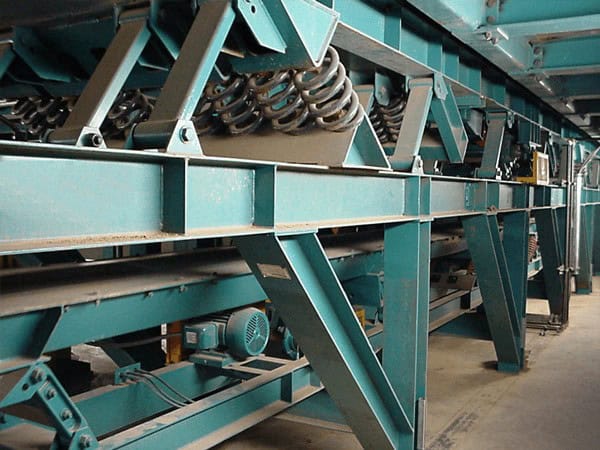
Overview
Not every vibratory conveyor application involves a ground-level foundry floor where vibration can transfer harmlessly into a concrete slab. Many industrial operations need to install vibratory equipment on mezzanines, elevated platforms, near sensitive machinery, or in buildings where uncontrolled vibration would damage surrounding infrastructure. The SYNCRO-COIL® vibratory conveyor with balanced and isolated mounting options is engineered for exactly these conditions.
This version of the SYNCRO-COIL uses the same proven alloy coil spring drive system as the foundry model, but adds aluminum rocker legs, counterpoised designs, and isolation systems that absorb or redirect reaction forces. The result is a vibratory conveyor that handles medium and heavy-duty material loads without transmitting damaging vibration to the surrounding structure.
Aluminum Rocker Legs
Standard vibratory conveyor legs are typically steel. The SYNCRO-COIL vibratory conveyor uses aluminum rocker legs that provide two advantages over steel. First, aluminum is significantly lighter, which reduces the total vibrating weight of the machine. Less vibrating weight means less energy is needed to drive the system, and the forces transmitted to the mounting structure are lower. Second, aluminum conducts heat away from the leg bushings far more efficiently than steel. Cooler bushings wear more slowly, which extends component life and reduces maintenance downtime. Less weight and less heat translate directly to more uptime.
Balanced and Isolated Mounting
In many industrial installations, the forces generated by a vibratory conveyor cannot be allowed to reach the surrounding supports or building steel. General Kinematics addresses this with multiple counterpoised and isolation designs that can be matched to the specific installation.
Options include duplicate trough reactor assemblies that balance the conveying trough against a counter-mass, sub-base to earth spring systems that isolate the conveyor from the floor, and positively driven balancer masses that move 180 degrees out of phase with the trough to cancel reaction forces. General Kinematics works with each customer to determine which design suits the process application, structural conditions, and vibration-sensitivity requirements of the facility.
Features and Benefits
- Rugged long-life alloy coil springs for consistent vibratory performance under sustained operation
- Aluminum rocker legs reduce vibrating weight and dissipate heat for longer component life
- Balanced and isolated mounting configurations minimize vibration transmission to surrounding structures
- Light-duty and heavy-duty construction options to match the material load
- Multiple drive and isolation configurations for application-specific engineering
- Heavy-duty trough construction for large material loads
- Operates reliably in dusty or difficult atmospheres
- Each machine is designed specifically for the application
Applications
The balanced SYNCRO-COIL vibratory conveyor serves a broader range of industrial environments than the foundry-specific model. Common applications include bulk material processing in chemical plants, aggregate and mineral handling, recycling and waste processing, food ingredient conveying in heavy-duty environments, manufacturing process lines, and any installation where the conveyor must operate on elevated structures, near vibration-sensitive equipment, or within buildings where structural vibration is a concern.
SYNCRO-COIL Vibratory vs. SYNCRO-COIL Foundry
Both conveyors use the same SYNCRO-COIL alloy coil spring drive system. The difference is in the mounting, leg construction, and target environment. The foundry model uses heavy-duty steel construction with the SYNCRO-CUSHION™ drive optimized for extreme heat, abrasion, and overload protection at the shakeout floor. This balanced model adds aluminum rocker legs and isolated mounting options for installations where vibration control matters as much as material durability — mezzanines, upper floors, adjacent to precision equipment, and within building steel that cannot absorb vibratory forces.