

Overview
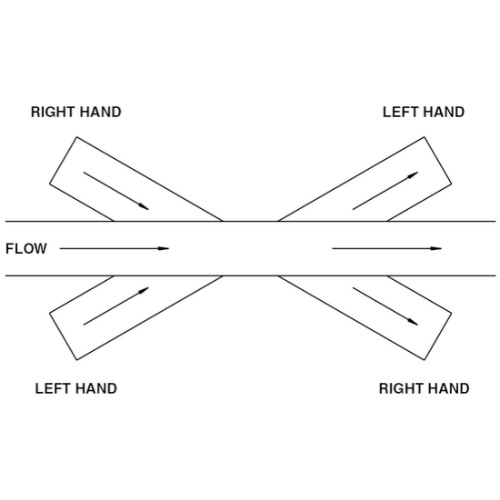
A gravity butt spur is a non-powered conveyor section that connects to the side of a mainline gravity conveyor at an angle, creating a divert or merge point where products can be routed off the main line or fed onto it. Roach gravity butt spurs are available in two bed types — galvanized steel rollers and ball bearing skatewheels — and connect at 30-degree or 45-degree angles in both right-hand and left-hand flow configurations. A 90-degree divert is also achievable by adding a standard 45-degree curve to the spur.
Butt spurs connect to the mainline with the end of the spur butting against the side of the mainline frame. This creates a clean junction point without requiring the mainline conveyor to be modified or interrupted. The hook and rod coupling on the spur frame allows for fast, tool-free connection to compatible gravity conveyor sections.
Specifications
The Model BSR (Roller) uses 1-3/8-inch diameter x 18-gauge galvanized steel rollers. This is the same roller specification used on the Roach 138G gravity conveyor line, providing consistent roller size and load rating between the spur and the mainline when paired with 138G straight sections and curves.
The Model BSW (Skatewheel) uses 1-15/16-inch diameter prelubricated ball bearing wheels with a hardened raceway and zinc plating. Skatewheels provide lower rolling resistance than rollers for lighter products and are well suited for parcels, polybags, envelopes, and flat-bottomed packages that do not require the full surface contact of a roller.
Both models use formed galvanized steel channel frames measuring 2-1/2 inches by 1 inch in 12-gauge construction. Frames are supplied with hook and rod coupling for quick connection to the mainline conveyor.
Divert Angles and Flow Direction
Roach butt spurs are available in 30-degree and 45-degree divert angles. The 30-degree spur provides a gradual departure from the mainline, which is useful when products must transition smoothly at higher gravity speeds or when floor space allows for a longer spur approach. The 45-degree spur provides a steeper divert angle for more compact layouts where the spur must reach a workstation, packing area, or secondary line in a shorter distance.
Both angles are available in right-hand flow and left-hand flow configurations. Right-hand flow diverts products to the right side of the mainline when looking in the direction of travel. Left-hand flow diverts to the left. A 90-degree divert is created by adding a standard 45-degree gravity curve to the end of the butt spur, redirecting products into a full perpendicular path.
Roller vs. Skatewheel
The roller spur (BSR) uses galvanized steel rollers that provide a continuous cylindrical contact surface. Rollers support heavier products, maintain better contact with irregular bottom surfaces, and are the standard choice when the spur must handle the same product mix as a roller-based mainline conveyor.
The skatewheel spur (BSW) uses individual ball bearing wheels that spin independently. Skatewheels have lower rolling resistance and are ideal for lightweight, flat-bottomed products such as parcels, small cartons, polybags, and envelopes. Skatewheel spurs are commonly used in parcel sorting, e-commerce fulfillment, and shipping operations where speed and light product handling are priorities.
Applications
Gravity butt spurs are used wherever products must be diverted from a mainline gravity conveyor onto a branch line or workstation. Common applications include parcel sorting lines where products are manually pushed onto spurs by destination, packing station feeds where cartons are diverted from a trunk line to individual packing positions, order consolidation areas where picks from multiple zones merge onto a shipping line, and truck loading operations where products are routed from a mainline to specific trailer doors or staging lanes.
Selection Assistance
Select the roller spur (BSR) when handling heavier cartons, totes, or products with irregular bottoms, or when the mainline uses roller conveyors. Select the skatewheel spur (BSW) for lightweight parcels and flat-bottomed packages. Determine whether a 30-degree or 45-degree divert angle fits the layout, and specify right-hand or left-hand flow based on the direction products must travel off the mainline.
Barron Equipment can help integrate butt spurs into a complete gravity conveyor layout. Request a quote to get started.