
Overview
Push plates, touchless actuators, and wireless transmitters are the visible components of an automatic door activation system — the parts the building occupants see and interact with. Relay modules are the invisible components. They mount inside or beside the door operator and handle the control logic that translates activation signals into door operator commands. Without the relay module, the activation device sends a signal that has nowhere to go.
Barron Equipment stocks two BEA relay modules that serve different functions in automatic door systems: a 2-relay logic module with a built-in 900 MHz wireless receiver, and a micro-processed lock-out relay module for Parallax automatic door operator systems.
Available Products
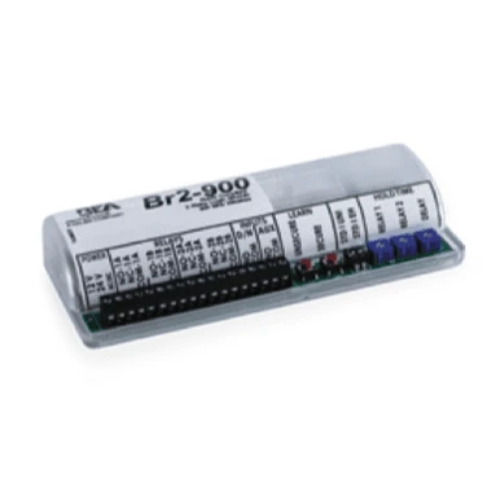
10BR2-900 — BEA 2-Relay Logic Module with 900 MHz Receiver
This module combines two functions in a single unit: a 900 MHz wireless receiver and a 2-relay logic controller. The built-in receiver picks up wireless signals from BEA’s 900 MHz transmitters — including the hi-accessibility handheld transmitter, the touchless retrofit transmitter, and any Panther Series push plate with an integrated 900 MHz wireless transmitter. When the receiver picks up an activation signal, the relay logic processes it and closes the appropriate relay to trigger the door operator.
The two-relay configuration allows the module to control multiple operator functions from wireless signals. Depending on the installation, the two relays can be configured for separate open and close commands, for activation from two independent transmitter channels, or for primary activation plus a secondary function such as a hold-open command. This is the receiver module that completes any BEA 900 MHz wireless door activation system.
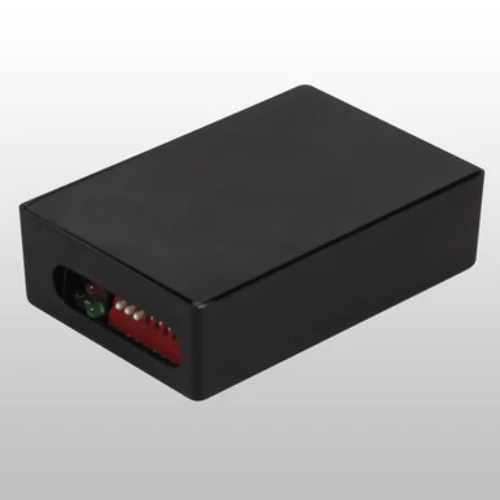
10LO21P — BEA Parallax Lock-Out Relay Module
A micro-processed relay module designed specifically for Parallax automatic door operator systems. This module manages the lock-out logic that controls when the door can and can’t be opened by activation devices. When the lock-out is engaged — typically after business hours or during a security event — the module overrides the activation inputs so push plates, touchless actuators, motion sensors, and transmitters can’t open the door. When the lock-out is released, normal activation resumes.
The lock-out relay manages the sequencing between the door lock and the operator. When the door is locked, the operator must not try to drive the door open against the lock — doing so damages the lock, the operator, or both. The lock-out relay ensures the lock releases before the operator receives the open command, and that the lock re-engages only after the door has fully closed. This sequenced control protects the hardware and prevents the mechanical conflicts that occur when locks and operators fight each other.
Where Relay Modules Fit in the System
An automatic door activation system has three layers:
Activation devices — push plates, touchless actuators, motion sensors, and wireless transmitters. These are what the user interacts with or what detects the user’s presence. They generate the “open the door” signal.
Relay modules — the control layer between the activation devices and the door operator. The relay module receives the activation signal (wirelessly or through hardwiring), applies any control logic (lock-out, sequencing, relay timing), and passes the processed command to the operator.
Door operator — the motorized unit that physically opens and closes the door. It receives the relay command and drives the door.
The relay module sits in the middle. It’s the brain that decides whether an activation signal should result in the door opening — based on lock status, timing, relay configuration, and system logic.
The 900 MHz Receiver — Completing the Wireless System
If the automatic door system uses any BEA 900 MHz wireless transmitter — handheld accessibility transmitters, retrofit transmitters on push plates, or Panther push plates with integrated wireless — the system needs a 900 MHz receiver at the door operator to complete the wireless link. The 10BR2-900 module provides that receiver along with the relay logic to process the signals. Without a receiver, the transmitters send signals that nothing picks up.
The module can be paired with multiple transmitters simultaneously. A single 10BR2-900 at the door can receive signals from multiple hi-accessibility handheld transmitters (one per user), a retrofit transmitter on the wall-mounted push plate, and any other BEA 900 MHz device — all communicating through one receiver.
Lock-Out Logic — Why Sequencing Matters
Automatic doors in commercial buildings are typically locked after hours using an electric lock or magnetic lock integrated into the door frame. When the building is locked, the door must not respond to activation signals — otherwise anyone with a push plate or motion sensor could trigger the door to open against the lock.
The lock-out relay module handles this in two ways. First, it blocks activation signals from reaching the operator when the lock is engaged, preventing the operator from trying to open a locked door. Second, when the lock is released for normal business hours, the relay ensures proper sequencing — the lock disengages first, then the operator receives the open command. On closing, the door fully closes first, then the lock re-engages.
Without this sequencing, the operator can try to drive the door open while the lock is still engaged, or the lock can try to engage while the door is still partially open. Both scenarios cause mechanical damage and system failures.
Selection Assistance
Select the module based on the system requirement. If the door system uses BEA 900 MHz wireless transmitters, the 10BR2-900 provides the receiver and relay logic needed to complete the wireless communication loop. If the door uses a Parallax automatic door operator and needs lock-out control for after-hours security, the 10LO21P provides the sequenced lock-out relay logic. Some installations may require both — wireless activation during business hours with lock-out control after hours. Contact Barron Equipment for help configuring relay modules for your automatic door system.