
Edge of Dock Leveler Installation Requirements: Steel Faces, Dock Heights & Concrete Anchors
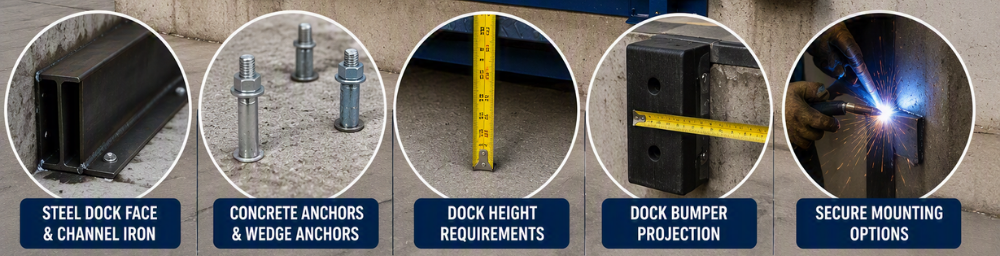
What Is Required to Install an Edge of Dock Leveler?
An edge of dock leveler is mounted directly to the face of the loading dock rather than inside a recessed pit. Because the unit transfers significant loading forces into the dock structure, the dock must provide adequate support for the leveler and the loads crossing it.
Most installations require:
- A structurally sound loading dock
- Proper dock face preparation
- Steel mounting surfaces or structural reinforcement
- Suitable dock height conditions
- Proper bumper placement
- Appropriate anchoring or welding methods
- Adequate clearance for operation and maintenance
A site inspection is often the best way to determine installation readiness.
| Installation Factor | Why It Matters | What to Verify |
|---|---|---|
| Steel Dock Face | Provides a stable mounting surface and supports operational loads. | Existing structural steel is present or can be added. |
| Channel Iron | Reinforces the dock face and improves load distribution. | Steel reinforcement is properly sized and positioned. |
| Concrete Condition | Supports the leveler and transferred forklift loads. | No severe cracking, spalling, or structural damage. |
| Dock Height | Affects leveler working range and trailer compatibility. | Trailer heights fall within the manufacturer’s operating range. |
| Wedge Anchors | Secure the leveler to the dock structure. | Concrete is suitable for anchor installation. |
| Welded Connections | Creates a permanent attachment to structural steel. | Steel components are available for welding. |
| Dock Bumper Projection | Maintains proper trailer spacing and leveler operation. | Bumpers provide adequate projection and clearance. |
| Trailer Traffic Volume | Helps determine whether an edge of dock leveler is the right solution. | Traffic levels match the intended use of the equipment. |
| Forklift & Load Weight | Determines required capacity rating. | Combined forklift and load weight are known. |
| Retrofit Compatibility | Identifies whether modifications are needed. | Existing dock structure can support installation. |
| Common Equipment | Forklifts and palletized loads | Forklifts, heavy loads, frequent cycles |
| Facility Fit | Existing docks without pits | New construction or docks with pits |
Understanding Steel Dock Face Requirements
One of the most important installation considerations is the condition of the dock face.
Because edge of dock levelers are mounted directly to the front of the dock, the mounting area must be capable of handling repeated forklift and load impacts transferred through the leveler.
Many installations utilize structural steel welded to the dock face to create a secure mounting surface.
Why a Steel Dock Face Matters
A steel dock face helps:
- Distribute loading forces
- Improve long-term durability
- Support welding requirements
- Reduce mounting movement
- Minimize structural stress on concrete edges
Without adequate structural support, the dock face may not be suitable for edge of dock leveler installation.
What Is Channel Iron and Why Is It Used?
Channel iron is a common structural steel component used during loading dock construction and retrofits.
For edge of dock leveler installations, channel iron may be installed along the dock face to provide a durable mounting surface capable of supporting operational loads.
Benefits of channel iron include:
- Improved structural reinforcement
- Better load distribution
- Increased mounting stability
- Reliable welding surfaces
- Long-term durability
Channel iron is particularly important when retrofitting older loading docks that may not have been designed for modern loading dock equipment.
Concrete Dock Preparation
Concrete condition plays a major role in successful installation.
Even when steel reinforcement is used, the underlying concrete must be capable of supporting the equipment and operational loads.
Before installation, technicians often inspect for:
- Cracking
- Spalling
- Surface deterioration
- Uneven dock faces
- Previous repairs
- Structural damage
Any deficiencies should be addressed before mounting a new edge of dock leveler.
Wedge Anchors vs. Welding
Depending on the dock design and manufacturer recommendations, edge of dock levelers may be installed using welded connections, concrete anchors, or a combination of both.
Wedge Anchors
Wedge anchors are mechanical fasteners installed into concrete.
Advantages include:
- Strong hold in sound concrete
- Reduced installation time
- Compatibility with retrofit projects
- Secure attachment to reinforced dock structures
Welded Installations
Some edge of dock leveler designs utilize welding to structural steel components integrated into the dock face.
Advantages include:
- Permanent attachment
- Excellent structural strength
- Consistent alignment
- Long-term durability
The appropriate installation method should always follow manufacturer specifications and site conditions.
Dock Height Requirements
Dock height plays an important role in determining whether an edge of dock leveler is the right solution.
Unlike pit-style levelers, edge of dock levelers operate within a more limited working range.
Facilities should evaluate:
- Typical trailer heights
- Trailer suspension types
- Loading conditions
- Seasonal variations in trailer height
- Existing dock elevation
When trailer heights vary significantly, a pit-style dock leveler may provide greater operational flexibility.
Understanding Working Range
Every edge of dock leveler operates within a specified working range.
Working range refers to the distance above and below dock level where the leveler can safely bridge the trailer.
Facilities with relatively consistent trailer heights are often ideal candidates for edge of dock levelers.
Facilities experiencing substantial trailer height variation should verify operating ranges with manufacturer specifications before purchasing equipment.
Dock Bumper Projection Requirements
Dock bumpers protect both the dock structure and trailers during loading operations.
However, bumper projection can also impact edge of dock leveler performance.
Why Bumper Projection Matters
Improper bumper placement may:
- Interfere with leveler operation
- Affect trailer contact points
- Reduce usable working range
- Create clearance issues
Proper bumper projection helps ensure the trailer maintains appropriate positioning during loading and unloading operations.
Can an Existing Dock Support an Edge of Dock Leveler?
Many existing loading docks can be retrofitted with edge of dock levelers, but not every facility is automatically a candidate.
Factors that influence retrofit suitability include:
- Dock condition
- Concrete integrity
- Steel reinforcement availability
- Trailer traffic volume
- Existing bumper configuration
- Dock elevation
- Equipment capacity requirements
A professional site evaluation can identify any structural modifications needed before installation.
Edge of Dock Leveler Installation Checklist
Before selecting an edge of dock leveler, verify:
✅ Concrete dock is structurally sound
✅ Dock face can support mounting loads
✅ Structural steel or channel iron is present or can be added
✅ Trailer heights are relatively consistent
✅ Bumper projection is adequate
✅ Installation method has been determined
✅ Capacity requirements have been verified
✅ Loading patterns have been reviewed
✅ Clearance requirements have been confirmed
✅ Manufacturer installation guidelines have been reviewed