
Edge of Dock Leveler Installation Requirements: Steel Faces, Dock Heights & Concrete Anchors
Understanding Edge of Dock Leveler Installation Requirements
Edge of dock levelers are designed to provide a permanent bridge between the warehouse floor and trailer bed without requiring the excavation and pit construction associated with traditional pit-style dock levelers. Because these systems mount directly to the face of the loading dock, proper dock preparation is essential to ensure safe operation, long-term durability, and reliable performance.
Before purchasing or installing an edge of dock leveler, facility managers should evaluate dock height, dock face construction, mounting surfaces, bumper projection requirements, and anchoring methods to determine whether a facility is a suitable candidate for this type of loading dock equipment.
What Is an Edge of Dock Leveler?
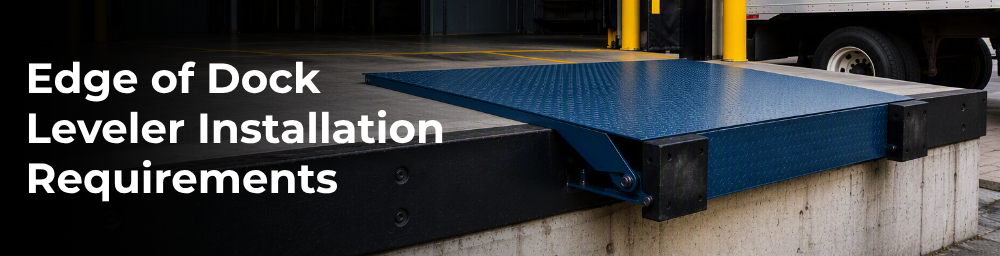
An edge of dock leveler is a permanent loading dock device mounted directly to the concrete dock face to bridge the gap between trailers and the warehouse floor. Serving as an economical alternative to pit-style levelers, edge of dock levelers are available in mechanical and hydraulic configurations and are commonly used in facilities where trailer heights remain within a relatively narrow operating range.
Because edge of dock levelers do not require a pit, installation is generally faster and less disruptive than many traditional dock leveling systems.
Steel Dock Face Requirements
One of the most important installation considerations is the condition and construction of the loading dock face.
Most edge of dock levelers are designed to mount to a steel-reinforced dock face capable of supporting the operational forces generated during loading and unloading activities. The dock face must provide sufficient structural integrity to support both the leveler and the loads being transferred across it.
Facility managers should inspect the dock edge for:
- Structural damage
- Concrete deterioration
- Cracking or spalling
- Corroded steel components
- Uneven mounting surfaces
- Existing dock modifications
A properly prepared dock face helps ensure secure attachment and safe operation throughout the life of the equipment.
Dock Height Requirements
Edge of dock levelers perform best when trailer heights remain reasonably consistent.
Unlike pit-style dock levelers that accommodate a wider range of trailer positions, edge of dock levelers are typically intended for facilities operating within a limited working range above and below dock height. Facilities with highly variable trailer heights may require a different loading dock solution.
When evaluating dock height compatibility, facility managers should consider:
- Current dock height
- Typical trailer bed heights
- Trailer suspension variations
- Seasonal loading conditions
- Facility traffic patterns
- Forklift operating requirements
Understanding these factors helps determine whether an edge of dock leveler is the appropriate solution for the application.
Concrete Preparation Considerations
The quality of the existing concrete structure plays a major role in successful installation.
Before mounting an edge of dock leveler, installers should verify that the concrete surrounding the dock edge is capable of supporting the required anchor system and operational loads.
Areas that should be evaluated include:
- Concrete thickness
- Surface condition
- Existing repairs
- Cracks near anchor locations
- Reinforcement conditions
- Overall dock integrity
If significant deterioration exists, repairs may be required before installation can proceed.
Wedge Anchors and Mechanical Anchoring Systems
Many edge of dock leveler installations utilize anchor systems designed to secure the leveler frame to the dock structure.
Depending on the dock design and manufacturer requirements, installation methods may involve:
- Wedge anchors
- Mechanical anchors
- Expansion anchors
- Structural mounting hardware
- Reinforcement brackets
Proper anchor selection is critical for maintaining long-term stability and ensuring the leveler remains securely attached during repeated loading cycles.
Because anchor requirements may vary by product model and dock configuration, installation should always follow manufacturer specifications.
Welding and Structural Attachment Considerations
Some installations may require welding or structural attachment methods depending on dock conditions and equipment specifications.
When welding is required, facility managers should ensure that mounting surfaces are properly prepared and that installation practices comply with applicable safety requirements and manufacturer recommendations.
Common considerations include:
- Steel face preparation
- Structural reinforcement requirements
- Existing steel conditions
- Corrosion protection
- Attachment point locations
- Long-term load distribution
Proper structural preparation helps maximize equipment performance while reducing maintenance concerns.
Dock Bumpers and Projection Requirements
Dock bumpers play an important role in protecting loading dock equipment and buildings from trailer impact.
Before selecting an edge of dock leveler, facilities should evaluate:
- Existing bumper projection
- Bumper condition
- Trailer approach characteristics
- Dock face clearance
- Building protection requirements
Proper bumper projection helps ensure adequate clearance for both trailers and leveler operation.
Mechanical vs. Hydraulic Installation Considerations
While both mechanical and hydraulic edge of dock levelers mount directly to the dock face, installation requirements may differ.
Mechanical Edge of Dock Levelers
Mechanical models are commonly selected for facilities seeking a cost-effective loading dock solution with fewer powered components.
Benefits may include:
- Simpler installation
- Lower equipment costs
- Reduced electrical requirements
- Straightforward operation
Hydraulic Edge of Dock Levelers
Hydraulic models offer powered operation and may be preferred for facilities with higher loading frequencies.
Benefits may include:
- Easier operation
- Reduced manual effort
- Improved productivity
- Consistent deployment
The ideal choice depends on facility traffic volume, operational requirements, and loading dock workflows.
Common Installation Mistakes to Avoid
Successful installations begin with proper planning and dock evaluation.
Common issues include:
- Selecting a leveler for an incompatible dock height
- Ignoring dock face condition
- Overlooking concrete damage
- Improper anchor selection
- Insufficient bumper projection
- Failing to review manufacturer specifications
- Choosing equipment based solely on initial cost
Addressing these factors early can help reduce maintenance issues and improve equipment longevity.
Frequently Asked Questions
Do edge of dock levelers require a pit?
No. Edge of dock levelers mount directly to the face of the loading dock and do not require a dock pit.
Can edge of dock levelers be installed on concrete docks?
Yes. However, the condition, strength, and configuration of the concrete structure should be evaluated before installation.
What is the ideal dock height for an edge of dock leveler?
The ideal dock height depends on the trailer heights regularly serviced at the facility. Edge of dock levelers are generally best suited for facilities where trailer heights remain relatively consistent.
Are edge of dock levelers welded or anchored?
Installation methods vary by manufacturer and facility conditions. Some systems utilize anchors, while others may involve structural attachment methods depending on project requirements.
Why are dock bumpers important?
Dock bumpers help protect both the loading dock structure and dock equipment from trailer impact while helping maintain proper operating clearances.
Conclusion
Proper installation is one of the most important factors influencing the performance, safety, and lifespan of an edge of dock leveler. By evaluating dock face construction, dock height compatibility, concrete condition, anchoring requirements, bumper projection, and equipment type before installation, facilities can select a solution that provides reliable loading dock performance for years to come.