
In-Plant Offices on Mezzanines: How to Double Your Warehouse Footprint
Posted on by Samantha Lyon
Why Warehouse Space Is More Valuable Than Ever
Warehouse managers constantly face the challenge of increasing productivity without expanding facility footprints. As inventory levels rise, equipment requirements change, and administrative functions grow, available floor space can quickly become limited. For many facilities, the most underutilized resource is not additional land or square footage. It is vertical space. One increasingly popular solution is combining modular office systems with industrial mezzanines to create elevated workspace without sacrificing valuable production or storage areas.What Is an In-Plant Office?
An in-plant office is a modular building installed within an existing warehouse, manufacturing plant, distribution center, or industrial facility. These structures create dedicated work environments while remaining integrated into ongoing operations. Common uses include:- Management offices
- Conference rooms
- Quality control areas
- Engineering offices
- Training rooms
- Break rooms
- Process monitoring stations
What Is an Industrial Mezzanine?
An industrial mezzanine is an elevated structural platform installed within an existing building to create additional usable floor space. Rather than expanding outward, mezzanines take advantage of unused vertical clearance inside a facility. Mezzanines can support:- Storage systems
- Equipment platforms
- Material handling operations
- Elevated offices
- Workstations
- Production support areas
Why Combine Offices and Mezzanines?
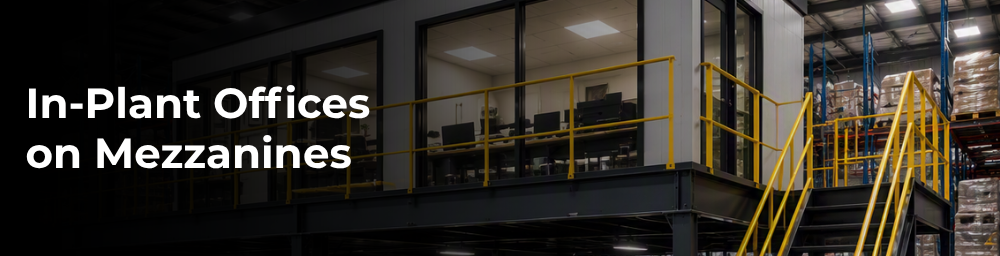
The analysis specifically identified mezzanine-mounted office configurations as an important search entity that competitors emphasize heavily. By positioning modular offices on mezzanine structures, facilities can preserve valuable floor space while adding functional office environments. This approach allows organizations to maximize both horizontal and vertical space utilization.Benefits of Elevated Modular Offices
Preserve Floor Space
Operations continue below the office while administrative activities occur above.Improve Facility Visibility
Managers and supervisors often gain improved visibility across warehouse and production operations.Increase Functional Space
Facilities can create office environments without consuming warehouse storage capacity.Support Future Expansion
Modular systems and mezzanines can often be modified as operational requirements evolve.Accelerate Installation
Compared to traditional construction, modular office systems may offer faster implementation.Typical Applications
In-plant mezzanine offices are commonly used for:Manufacturing Facilities
Provide oversight of production operations while maintaining proximity to manufacturing activities.Distribution Centers
Create management and supervisory spaces overlooking warehouse operations.Quality Control Areas
Establish inspection and testing environments near active production lines.Engineering Departments
Provide workspace for technical teams supporting manufacturing operations.Warehouse Administration
Create office environments without sacrificing inventory storage capacity.Structural Design Considerations
When evaluating mezzanine office projects, facilities should consider:- Building clear height
- Load capacity requirements
- Access stairs
- Traffic flow
- Fire protection requirements
- Lighting considerations
- HVAC requirements
- Future expansion goals
Common Modular Building Materials
The analysis specifically recommends discussing system components and panel materials more directly. Common modular office configurations may include:- Vinyl-clad gypsum wall systems
- Steel-faced panels
- Fiberglass-reinforced plastic (FRP) panels
- Expanded polystyrene (EPS) core insulation
- Integrated window systems
- Pre-engineered structural components