
Edge of Dock Leveler vs. Pit-Style Leveler vs. Dock Boards: Selection Guide
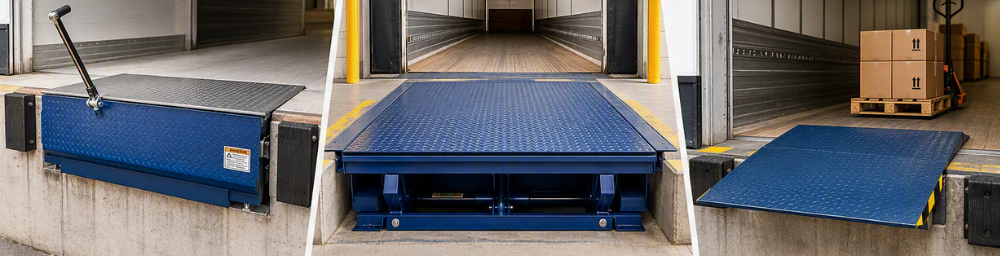
Why Choosing the Right Dock Bridging Equipment Matters
Every loading dock needs a way to bridge the gap between the warehouse floor and the bed of a truck trailer. That gap changes with every truck that backs in. Different trailer heights, suspension types, and load weights all create variation that your bridging equipment must handle safely.
Choosing the wrong solution leads to problems. An undersized dock plate slows down forklift traffic. An edge of dock leveler installed where a pit-style leveler was needed leaves workers fighting steep grades all day. And a facility that invests in a full pit leveler for two trucks a week may have spent five times more than necessary.
This guide compares the three most common loading dock bridging solutions — edge of dock levelers, pit-style dock levelers, and dock boards — so you can match the right equipment to your facility’s traffic, budget, and operational requirements.
Edge of Dock Levelers
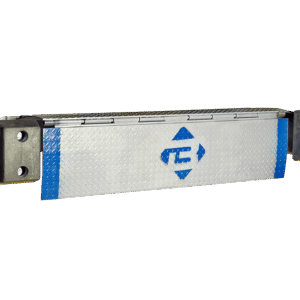
Edge of dock levelers are available in mechanical and hydraulic configurations. Mechanical models like the Bluff EZ-Pull mechanical edge of dock leveler use a spring-assisted handle to position the deck and lip. Hydraulic models use push-button controls for powered operation. Barron carries both types through our Poweramp edge of dock leveler line as well as the Bluff Model EP.
|
|
|

|
|---|---|---|
|
|
Bluff EZ-Pull Mechanical Edge of Dock Leveler | Model EP | Edge of Dock Levelers - Mechanical & Hydraulic |
The main advantage of an EOD leveler is its low cost and fast installation. Because no pit excavation is required, most units can be welded to the steel dock face and put into service within one to two days. This makes edge of dock levelers an attractive option for facilities that are retrofitting existing docks or operating in leased spaces where concrete work is not permitted.
The tradeoff is limited working range. If your trailers regularly arrive with bed heights more than 5 inches above or below your dock, an edge of dock leveler will not provide adequate coverage. The shorter deck also creates a steeper grade for forklifts to travel, which can increase equipment wear over time in high-cycle environments.
Pit-Style Dock Levelers
A pit-style dock leveler sits inside a recessed concrete pit built into the dock floor. When not in use the leveler deck rests flush with the floor, keeping the dock surface clear for cross-traffic. When a truck arrives the operator raises the deck and extends the lip onto the trailer bed.
Pit-style levelers are available in mechanical, air-powered, and hydraulic configurations. Barron Equipment carries the full Poweramp lineup including the CM Series mechanical dock leveler, the HM Series heavy duty mechanical dock leveler, the LHP Series hydraulic dock leveler, and the PR Series heavy duty hydraulic dock leveler.
Dock Boards and Dock Plates
Dock boards and dock plates are portable loading dock bridging devices. They are placed between the dock and trailer when needed, then removed or stored after use. Unlike edge of dock levelers and pit-style levelers, they are not permanently mounted to the dock.
Dock plates are typically lighter-duty solutions used for hand trucks, carts, and pallet jacks. Dock boards are usually heavier-duty and may include side curbs to support forklift traffic.
What Is the Difference Between a Dock Board and a Dock Plate?
A dock plate is a portable plate used to bridge a small height difference or gap between the dock and trailer. Dock plates are commonly used for lighter loads and non-powered equipment like hand trucks and pallet jacks.
A dock board is a heavier portable bridge designed for more demanding applications. Dock boards often include side curbs and are used when forklifts or heavier loads need to cross between the dock and trailer.
Benefits of Dock Boards and Dock Plates
Portable dock boards and dock plates offer flexibility when permanent equipment is not required:
- Portable design: They can be moved between dock positions.
- Lower upfront cost: They are usually less expensive than permanent dock levelers.
- No installation required: Most units can be used without dock construction.
- Temporary solution: They can support loading needs while a facility plans for a permanent leveler.
- Useful for low-volume operations: They are practical when trucks are loaded or unloaded only occasionally.
Side-by-Side Comparison
| Feature | Edge of Dock Leveler | Pit-Style Dock Leveler | Dock Boards / Dock Plates |
|---|---|---|---|
| Mounting | Permanent, mounted to dock face | Permanent, recessed in concrete pit | Portable, placed and removed as needed |
| Pit Required | No | Yes | No |
| Best For | Moderate traffic and consistent trailer heights | High traffic and variable trailer heights | Light, temporary, or infrequent loading |
| Operation | Mechanical or hydraulic | Mechanical, hydraulic, or air-powered | Manual placement |
| Installation | Lower construction requirement | Requires pit construction or existing pit | No permanent installation |
| Forklift Transition | Shorter deck, steeper grade | Longer deck, smoother grade | Varies by model and application |
| Portability | Fixed in place | Fixed in place | Portable |
| Upfront Cost | Low to moderate | Moderate to high | Lowest |
| Traffic Level | Light-to-moderate | Moderate-to-heavy | Light or occasional |
| Common Equipment | Forklifts and palletized loads | Forklifts, heavy loads, frequent cycles | Hand trucks, pallet jacks, occasional forklift use with dock boards |
| Facility Fit | Existing docks without pits | New construction or docks with pits | Temporary or flexible loading areas |
How to Choose the Right Loading Dock Bridging Solution
Choosing between an edge of dock leveler, pit-style dock leveler, and dock board depends on how your loading dock operates every day. Use the following factors to narrow your options.
1. Trailer Height Variation
If your trailers arrive at consistent heights, an edge of dock leveler may provide the coverage you need. If your facility receives multiple trailer types with larger height differences, a pit-style dock leveler is usually the better fit.
Dock boards and dock plates can work for occasional loading, but they should be sized correctly for the height difference, load weight, and equipment being used.
2. Daily Truck Volume
Low-volume facilities may not need a permanent dock leveler at every door. Dock boards or dock plates can be practical for occasional loading.
Facilities with regular daily truck traffic usually benefit from a permanent solution. Edge of dock levelers work well for moderate volume, while pit-style dock levelers are better suited for high-throughput loading docks.
3. Forklift and Load Weight
The combined weight of the forklift and load should always be considered when selecting loading dock equipment. Heavier loads and frequent forklift use often point toward a pit-style dock leveler or a properly rated dock board.
For lighter palletized loads and consistent trailer heights, an edge of dock leveler may be the more cost-effective option.
4. Existing Dock Structure
If your dock already has a recessed pit, a pit-style dock leveler may be the natural fit. If your dock does not have a pit, an edge of dock leveler can provide a permanent solution without major concrete modification.
If permanent installation is not possible, dock boards and dock plates provide a portable option.
5. Budget and Long-Term Use
Dock boards and dock plates usually have the lowest upfront cost. Edge of dock levelers offer a permanent upgrade at a moderate investment. Pit-style dock levelers require more upfront construction but may provide better long-term performance for high-volume operations.
The best choice is not always the cheapest product. It is the solution that safely supports your loading volume, trailer range, equipment type, and long-term facility needs.
Final Recommendation
For many facilities, the decision comes down to traffic level and trailer height consistency.
If you load occasionally, use portable equipment, or need a budget-friendly temporary option, start with dock boards or dock plates.
If you need a permanent solution and your trailer heights are consistent, choose an edge of dock leveler.
If your loading dock handles heavy traffic, varying trailer heights, or frequent forklift operation, choose a pit-style dock leveler.
The right dock bridging solution helps support safer loading, smoother material handling, and more efficient movement between the warehouse and trailer.
Cookie Consent
We use cookies to improve your experience on our site. By using our site, you consent to cookies.
Cookie Preferences
Manage your cookie preferences below:
Essential cookies enable basic functions and are necessary for the proper function of the website.
Google Tag Manager simplifies the management of marketing tags on your website without code changes.
CloudFlare provides web performance and security solutions, enhancing site speed and protecting against threats.
Service URL: developers.cloudflare.com (opens in a new window)
Formidable Forms is a powerful WordPress plugin for creating advanced forms and data management solutions.
WooCommerce is a customizable eCommerce platform for building online stores using WordPress.
Statistics cookies collect information anonymously. This information helps us understand how visitors use our website.
Clarity is a web analytics service that tracks and reports website traffic.
Service URL: clarity.microsoft.com (opens in a new window)
SourceBuster is used by WooCommerce for order attribution based on user source.
Google Analytics is a powerful tool that tracks and analyzes website traffic for informed marketing decisions.
Service URL: policies.google.com (opens in a new window)
Marketing cookies are used to follow visitors to websites. The intention is to show ads that are relevant and engaging to the individual user.
CallRail is a call tracking and analytics service. Its script swaps the phone numbers shown on a page and stores the visitor's referrer, landing page and session ID, so phone calls and form submissions can be attributed to the marketing source that brought the visitor to the site.
Service URL: www.callrail.com (opens in a new window)
Google Ads is an online advertising platform that enables businesses to create targeted ads displayed on Google search results and partner sites.
Service URL: policies.google.com (opens in a new window)