
The Industrial Guide to Loading Dock Leveler Capacity Selection
How to actually choose the right capacity -- without guessing
If you’re trying to size a dock leveler, you’ve probably run into this question:
“What capacity dock leveler do I need for my forklift?”
It seems like a simple question to answer, but in reality, it’s one of the most commonly misunderstood parts of a loading dock.When it’s answered incorrectly, it not only causes wear and tear on the leveler, but it also leads to:
- Structural damage
- Frequent maintenance issues
- Premature equipment failure
- Debilitating and sometimes fatal injuries
Instead of making assumptions or defaulting to “whatever we’ve always used,” this guide walks through how to actually size dock levelers correctly.
Why Capacity Isn’t as Simple as It Looks
“If my forklift weighs 10,000 lbs, I need a 10,000 lb leveler.”Unfortunately, that’s not how dock levelers work. Because once a forklift starts moving across a leveler, the load is no longer static—it becomes dynamic. And that changes everything.
Static Capacity vs. Dynamic Capacity
Before you do any math, you need to understand this one concept.
Static Capacity
This is what most specs reference.
- Load sitting still
- Evenly distributed
- No movement, no impact
It’s basically a theoretical number.
Dynamic Capacity (What actually matters)
This is real-world performance.
It accounts for:
- Forklift movement
- Speed across the leveler
- Transition onto the dock
- Load shifting
- Impact forces
Bottom line:
The moment your forklift starts moving, the load increases.
That’s why it’s critical to never size a dock leveler off static capacity alone.
The Biggest Missed Factor: Forklift Axle Load
Where most capacity calculations breakdown is not just in the assumption of static load vs. dynamic load, but the fact that a forklift does not distribute weight evenly across the deck.
Instead:
- The front axle carries most of the load
- The weight becomes concentrated in a smaller area
- That creates significantly higher stress on the leveler
So even if your total weight looks reasonable, the actual force on the deck is much higher.
3-Wheel vs. 4-Wheel Forklifts (Yes, It Matters)

Not all forklifts operate the same way on a dock leveler.
3-Wheel Forklifts
- More concentrated load
- Smaller contact footprint
- Higher stress on deck and lip
4-Wheel Forklifts
- More evenly distributed load
- Lower point impact
If you’re running 3-wheel units, you should already be thinking:
“We probably need more capacity than the standard calculation.”
The Simple Way to Calculate Capacity
You don’t need complicated formulas to get this right.
You just need to follow the process.
Step 1: Add Your Weights
Forklift Weight + Heaviest Load = Total Load
Example:
- Forklift = 10,000 lbs
- Load = 4,000 lbs
- Total = 14,000 lbs
Step 2: Apply a Multiplier
This is where dynamic forces come in.
Typical multipliers:
- 2.0× → Light use
- 2.5× → Standard industrial use
- 3.0×+ → Heavy duty / high cycle / aggressive conditions
If you’re unsure, default to 2.5×. It’s a safe, realistic baseline.
Step 3: Calculate Required Capacity
Total Load x Multiplier = Required Capacity
Example:
14,000 x 2.5 = 35,000 lbs
Therefore, your selection becomes: 35,000-40,000 lbs dock leveler
Quick Reference: Common Scenarios
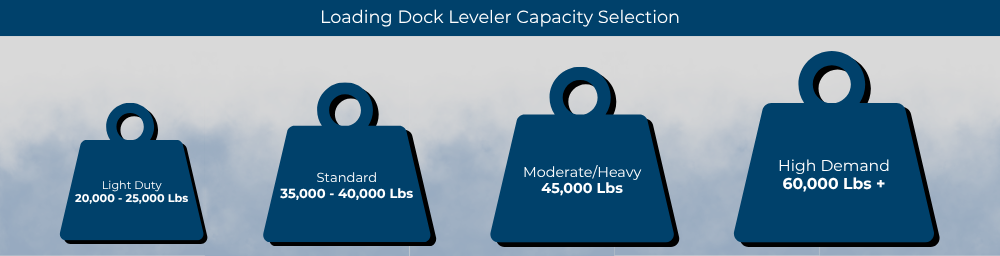
| Forklift + Load | Typical Use | Recommended Capacity |
|---|---|---|
| 8,000 + 2,000 | Light duty | 20,000-25,000 lbs |
| 10,000 + 4,000 | Standard | 35,000-40,000 lbs |
| 12,000 + 6,000 | Moderate/heavy | 45,000 lbs |
| 15,000 + 8,000 | High demand | 60,000 lbs+ |
When in doubt, it’s important to round up, not down. Capacity is one of the cheapest upgrades you can make compared to the cost of failure.
What Actually Drives Capacity Higher
It’s important to note that real-world applications can sometimes change the manual calculations. If any of the below apply, you should increase your multiplier:
- Steeper dock angles
- Forklifts hitting the leveler at speed
- Frequent daily cycles
- Forklift attachments (clamps, rotators, etc.)
- Turning on the leveler
- Narrow or solid tires
- 3-wheel forklifts
The Cost of Getting It Wrong
Under sizing a dock leveler doesn’t necessarily fail immediately.
It shows up over time in the following ways:
- Deck deflection (“dishing”)
- Hinge and structural fatigue
- Increased maintenance
- Shortened lifespan
If it doesn’t cause a major issue in the beginning, eventually, it turns into a replacement issue—not a repair.
At that point, the cost difference between a 35k and 45k unit is no longer relevant.
The Standard Behind It (ANSI MH14.1)
How We Approach It at Barron

Instead of simply asking for the capacity, our team requests more information about the application. We want to try and understand:
- What forklifts are actually being used
- The heaviest real-world load (not average)
- Traffic and cycle frequency
- Dock geometry and conditions
Bottom Line
If you retain anything from this guide, let it be that the dock leveler capacity is not about forklift weight — it’s about real-world impact.
Remember to use the total load, apply the multiplier and account for your actual operating conditions. Lastly, when in doubt, size up.
For assistance with loading dock equipment, fill out the contact form below and we’ll be in touch soon!