
Wheel Chocks vs. Vehicle Restraints: Which Dock Safety System is Best?
Why Loading Dock Safety Matters
Loading docks remain one of the busiest and most hazardous areas in industrial facilities. Every day, forklifts move between trailers and warehouse floors while employees work around moving equipment, heavy loads, and constantly changing trailer positions.
Without proper trailer securement, facilities face risks such as trailer creep, early departure, trailer movement, trailer pop-up, landing gear collapse, and trailer separation incidents. These hazards can increase the risk of equipment damage, cargo loss, operational disruptions, and workplace injuries.
As a result, facilities typically choose between two primary trailer securement methods: wheel chocks and vehicle restraints.
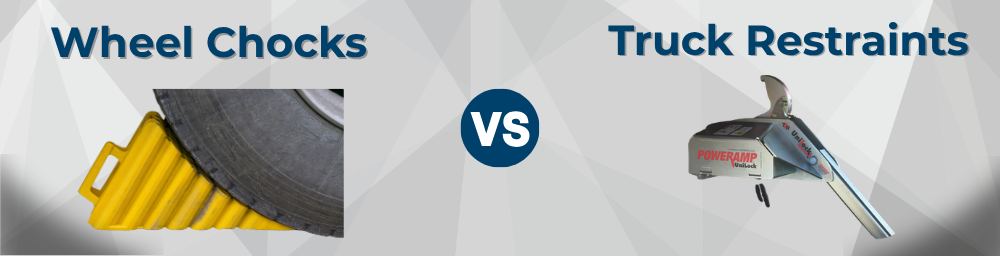
What Is a Wheel Chock?
A wheel chock is a device placed against a trailer tire to help reduce unwanted trailer movement during loading and unloading operations.
Traditional wheel chocks are commonly made from rubber, urethane, steel, or composite materials and rely on physical placement by employees before loading begins.
Some facilities also utilize electronic wheel chock systems that integrate with loading dock communication systems and interlocks to improve operational consistency.
What Is a Vehicle Restraint?
A vehicle restraint system, commonly known as a dock lock, is an industrial safety device designed to secure a semi-trailer’s rear impact guard (RIG) to a loading dock. By locking the vehicle in place, these systems help prevent trailer creep, landing gear collapse, and premature truck departure during forklift loading and unloading operations.
Vehicle restraints are available in mechanical, hydraulic, automatic, and barrier-style configurations depending on facility requirements.
Wheel Chocks vs. Vehicle Restraints
Wheel Chocks
Benefits include:
- Lower initial cost
- Simple operation
- Minimal installation requirements
- Portable deployment
- Suitable for select low-volume applications
Potential limitations include:
- Dependence on employee placement
- Exposure to weather conditions
- Reduced effectiveness if improperly positioned
- Increased opportunity for inconsistent use
Vehicle Restraints
Benefits include:
- Positive trailer engagement
- Secure connection to the trailer’s rear impact guard
- Reduced dependence on operator judgment
- Integration with communication lights and interlocks
- Improved overall loading dock safety
Potential limitations include:
- Higher upfront investment
- Installation requirements
- Equipment-specific compatibility considerations
How Vehicle Restraints Help Prevent Trailer Creep
Trailer creep occurs when the repeated movement of forklifts entering and exiting a trailer gradually pushes the trailer away from the dock.
As the gap widens, dock equipment and personnel may become exposed to dangerous operating conditions.
Vehicle restraints are specifically designed to help reduce trailer movement by securing the trailer to the dock structure throughout the loading process.
How Vehicle Restraints Help Prevent Early Departure
Early departure occurs when a driver pulls away from the dock before loading operations are complete.
Communication systems integrated into many restraint systems help create visual confirmation that loading is still in progress, reducing the likelihood of accidental trailer removal.
Which System Is Best?
The ideal solution depends on:
- Trailer volume
- Facility traffic
- Safety requirements
- Loading frequency
- Regulatory considerations
- Budget priorities
For many higher-volume facilities, vehicle restraints provide a more comprehensive dock safety solution because they physically secure the trailer rather than relying solely on wheel immobilization.
Frequently Asked Questions
Are wheel chocks still used?
Yes. Many facilities continue to use wheel chocks, particularly in lower-volume operations.
Are vehicle restraints safer than wheel chocks?
Vehicle restraints provide positive trailer engagement and are often preferred in facilities seeking enhanced dock safety.
Can wheel chocks and restraints be used together?
Some facilities utilize multiple layers of dock safety depending on operational requirements.
Conclusion
Both wheel chocks and vehicle restraints play important roles in loading dock safety. However, facilities seeking higher levels of trailer securement, improved operational consistency, and reduced exposure to trailer movement hazards often select vehicle restraint systems as part of a comprehensive dock safety program.